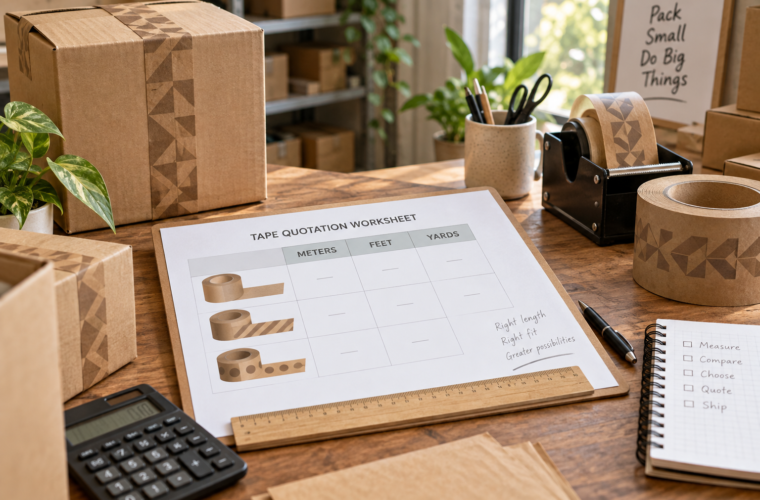
Choosing custom packaging tape starts with the shipping operation, not the logo. A defensible purchasing decision connects cartons, packed weights, routes, application, artwork, quantity, evidence, and commercial terms. It does not assume one tape format is suitable for every buyer.
Step 1: Define the Packaging Requirement
Create a requirement sheet before contacting suppliers:
- carton dimensions, board or surface, seam, and condition;
- packed weight and weight distribution;
- storage, route, and handling points;
- manual or equipment-based application;
- current packing-station constraints;
- branding objective and approved artwork;
- quantity estimate and destination;
- required tests, certifications, or customer standards;
- target decision date, clearly separated from an unconfirmed supplier schedule.
Group cartons with similar requirements, but retain representative demanding cases for evaluation.
Step 2: Shortlist Formats With Verified Data
For every candidate format, obtain direct product information covering material, adhesive/application method, dimensions, roll length, equipment, printing, performance evidence, samples, MOQ, pricing basis, lead time, shipping, and environmental claims.
Do not fill gaps with category assumptions. A field absent from a supplier source is Not specified.
BrandTapeCo water-activated option
BrandTapeCo confirms kraft and reinforced kraft materials, water-activated adhesive, 1.89 in (48 mm) and 2.36 in (60 mm) widths only, and one-color, two-color, and full-color printing. The standard online minimum is five 50 m rolls per design and color configuration. Sample availability depends on the reviewed order; production is typically 5–7 business days after proof approval, with shipping separate.
These facts describe one available option, not proof that it wins the shortlist.
Step 3: Build the Order Specification
Translate the shortlist into comparable fields:
| Field | Required buyer decision |
|---|---|
| Format and material | Proposed product/construction |
| Dimensions | Width and roll length |
| Printing | Colors, repeat, artwork, proofing questions |
| Application | Manual/equipment process and compatibility |
| Quantity | Initial estimate and reorder context |
| Evidence | Tests, documents, certifications, claims |
| Commercial | Price basis, sample terms, schedule, freight, destination |
Use the same field definitions for each supplier. Otherwise a quote comparison may hide differences in roll length, scope, freight, or evidence.
Step 4: Plan a Representative Sample Evaluation
Define the sample question before ordering. Use representative cartons, packed configurations, operators, equipment, and conditions. Record the exact product, material, width, roll, artwork, and application method.
Buyer-defined checks may include:
- application steps and station fit;
- width relative to the carton seam;
- print legibility and repeat appearance;
- compatibility with the intended equipment;
- closure behavior under the buyer's approved procedure;
- changeover, storage, and handling observations.
Do not convert one sample result into a universal load, adhesion, temperature, security, or environmental claim.
Step 5: Normalize Quotations
Compare the same width, roll length, material, printing, quantity, sample scope, packaging, shipping basis, and destination. Separate one-time costs, recurring product costs, equipment, freight, and buyer-side operating assumptions where the quotation provides them.
No BrandTapeCo price is specified. Do not publish savings or a cost-per-carton result without verified inputs.
Step 6: Use a Buyer-Defined Supplier Scorecard
| Decision area | Buyer-defined weight | Evidence to review |
|---|---|---|
| Specification match | Set before scoring | Product data and written quote |
| Sample result | Set before scoring | Recorded representative evaluation |
| Artwork process | Set before scoring | Confirmed file/proof requirements |
| Documentation | Set before scoring | Required tests/certificates and scope |
| Commercial terms | Set before scoring | MOQ, price, schedule, freight, payment terms |
| Operational fit | Set before scoring | Equipment, storage, training, changeover inputs |
Set weights before supplier review to reduce hindsight bias. Do not invent missing evidence or award a passing score to an unverified claim.
Step 7: Approve Claims Separately
Product approval does not automatically approve website language. Review security, environmental, certification, performance, delivery, stock, and customer claims against product-specific evidence. Record the exact wording, market, evidence, reviewer, and re-check date.
Common Selection Errors
- Starting with logo appearance while ignoring cartons and application.
- Comparing roll prices with different dimensions or freight terms.
- Treating a category description as a performance result.
- Using another supplier's MOQ, test, or certification.
- Skipping representative cartons during sampling.
- Choosing a format before defining required evidence.
- Publishing environmental or security claims from appearance alone.
Frequently Asked Questions
What is custom printed kraft paper tape?
It is kraft paper-backed tape printed with a logo, message or repeating design. The BrandTapeCo product uses water-activated adhesive and must be moistened with compatible dispensing equipment before it is applied to a corrugated carton.
What is the minimum order quantity for custom printed tape?
The BrandTapeCo standard online minimum is 5 rolls per design and color configuration. A different artwork, color, material or width may create a separate configuration.
How long does production take?
Digital proof preparation is typically planned for about 1 business day after the order and usable artwork are received. Production is typically planned for 5–7 business days after proof approval. Transit time depends on the delivery destination and is separate from production.
Is kraft paper tape strong enough for shipping?
It can be suitable for corrugated shipping cartons when the tape construction, width, activation and carton are compatible. Strength cannot be guaranteed from the backing description alone, so test the selected standard or reinforced configuration on representative packed boxes before scaling.
Request a Packaging Tape Specification Review
Send BrandTapeCo your requirement sheet, representative cartons, application method, artwork, preferred dimensions, quantity estimate, destination, sample plan, and required evidence. Ask for an order-specific proposal, then compare it with other verified options using the same decision framework.
After choosing the carton, width, material and application method, compare those requirements with the custom printed packing tape options and the current water-activated tape configuration.
Next step: explore BrandTapeCo custom packing tape for current configurations and order-specific details.