How wide should water-activated tape be for a carton? It needs to cover the intended seam and make usable contact with the board on both sides, but there is no honest universal overlap measurement for every box. Flap geometry, board finish, box size and application method differ. The practical choice is to compare the available widths on representative cartons, then test the actual tape and packing process.
Start with the widths you can actually buy
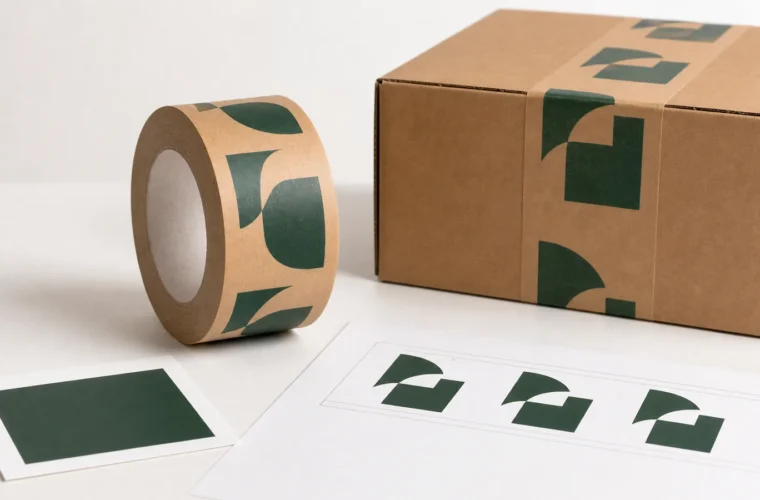
BrandTapeCo’s custom-printed water-activated tape is available in 48 mm or 60 mm width, with a standard online roll length of 50 m. No other printed width is offered, including 72 mm. The standard online minimum is five rolls per design and color configuration. A different roll length is not an online option; sales can assess feasibility and provide a separate written quote, but it cannot be promised in advance.
Do not choose 60 mm solely because it is wider, or 48 mm solely because it looks cheaper. Neither choice by itself proves a stronger seal. The correct question is whether the strip fits your seam, equipment and cartons without covering information or creating application problems.
Map the seam before comparing widths
- Pick representative boxes. Include your most common carton plus any narrow, large, heavily printed or different-board carton that could change the fit. Record the box dimensions and the closure pattern.
- Look at the closed flaps. Identify the center seam, the flat board available on each side and any gap, raised edge, label or print area in the tape path. A catalog photo cannot show these details on your boxes.
- Make two width mockups. Cut paper strips to 48 mm and 60 mm. Center each over the seam on the closed carton. Check where each edge lands, including near the carton ends and corners.
- Mark a normal cut length. Measure the strip your operator would dispense for that carton, including the way your team finishes the ends. If a printed logo must remain visible, look at where a repeat would be cut.
The paper mockup only checks geometry. It does not test adhesive contact, water activation or performance in transit. If the available flat board is irregular, or the strip rides over labels or a coated area, make that an explicit trial question rather than declaring the width suitable from appearance.
Compare the two candidates with a short record
| Record for each carton | What to write down |
|---|---|
| Seam and board | Carton ID, flap gap or unevenness, flat board on both sides, surface coating or dust. |
| 48 mm fit | Where the strip edges land; any label, corner or printing it covers. |
| 60 mm fit | The same observations on the same carton, so the comparison is fair. |
| Tape used per box | Measured strip length in your normal closure method, including end treatment. |
| Trial outcome | Actual tape, dispenser, operator, observation time and any visible lifting or placement issue. |
Use the mockup to decide which width is worth testing. Then run an application test on the actual cartons with the dispenser and wetting method your team will use. A clean-looking first strip is only one observation; it is not a shipping guarantee.
Estimate roll demand from your measured strip
For the standard 50 m roll, divide 50,000 mm by your measured millimeters of tape per box to get a theoretical maximum number of strips per roll. Round down, then allow for setup, trimming, operator variation and waste. This calculation is planning arithmetic, not a promised yield: your real consumption must come from the packing trial. For an order with several box sizes, calculate each size separately and use your expected mix.
Keep width and roll length separate in the purchase record. A 60 mm roll is wider, but both standard widths contain 50 m of tape per roll. Price, artwork configuration and shipping need to be compared on the actual selected specification rather than on strip count alone.
Make the order decision explicit
Choose the width that fits the seam on your relevant cartons and passes your own application checks. Save the carton photos, measured cut lengths and trial notes with the approved artwork. If one carton type needs a different closure method, do not silently assume the same result applies. Check the current product options before ordering, and ask sales about any carton-specific or nonstandard-length question.