Packing tape works by creating continuous contact between an adhesive system and the surface of a box. The backing carries the adhesive across the carton seam; application pressure, and sometimes water, helps the adhesive meet the board surface closely enough to form a useful seal.
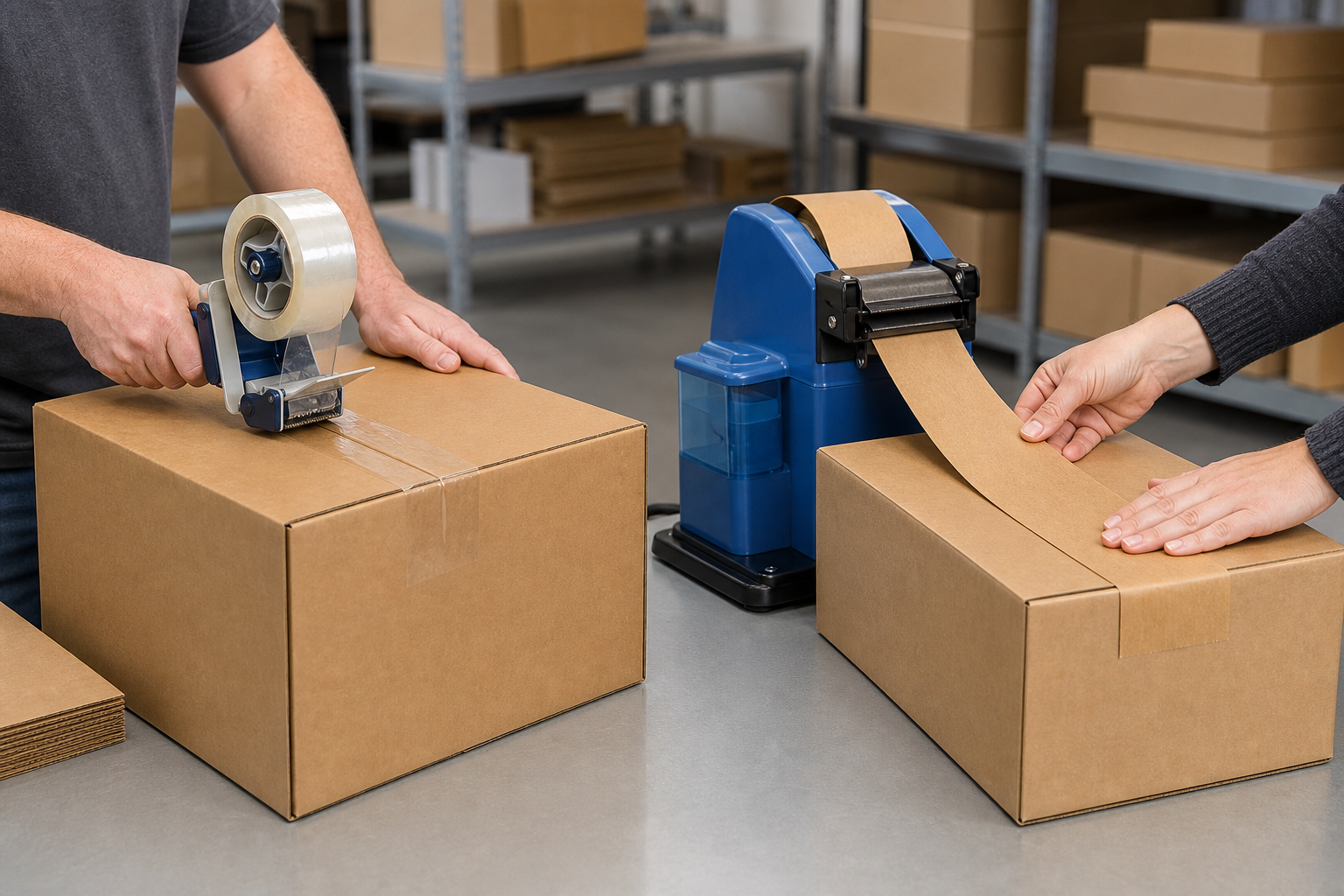
That broad answer covers two different mechanisms. Pressure-sensitive tape arrives tacky. Water-activated tape becomes tacky after wetting. Understanding both explains why the same roll can behave differently on dusty, coated, cold, or highly recycled corrugated boxes.
Two Main Ways Packing Tape Creates a Bond
| System | How adhesion starts | Critical application inputs |
|---|---|---|
| Pressure-sensitive tape | A tacky adhesive contacts the carton under pressure | Surface contact, application pressure, adhesive suitability, temperature |
| Water-activated tape | Water activates a dry adhesive before the strip contacts corrugated board | Wetting, cut length, timing, contact pressure, carton compatibility |
The tape backing supplies strength and handling. The adhesive creates the interface with the carton. A strong backing cannot compensate for poor surface contact.
How Pressure-Sensitive Packing Tape Works
Pressure-sensitive adhesive is designed to form a bond without water, heat curing, or a chemical mix at the packing station. When the operator or case sealer presses the tape against the carton, the adhesive flows into microscopic surface irregularities.
The initial bond depends on:
- sufficient pressure across the strip;
- adhesive contact rather than bridging over dust or texture;
- compatible application temperature;
- a carton surface the adhesive can wet;
- enough tape coverage and correct alignment.
The bond may develop after application, but the exact behavior depends on the product. Do not assume a universal dwell time or load rating.
How Water-Activated Packing Tape Works
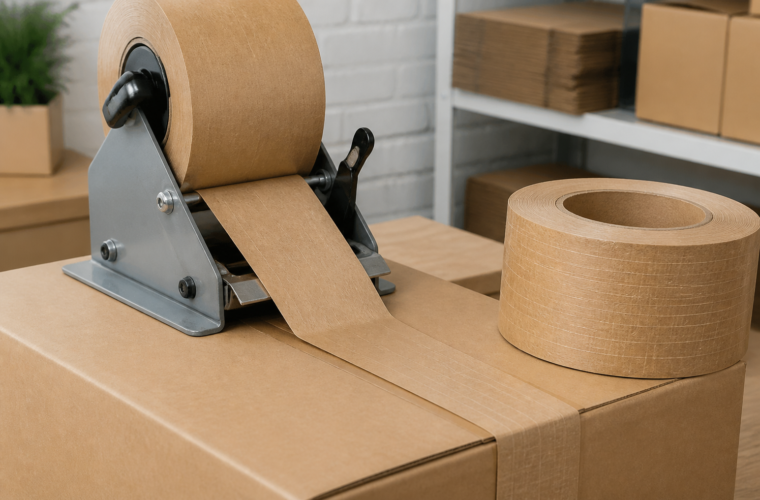
Water-activated tape begins with a dry adhesive layer. A dispenser moistens that layer, and the activated tape is pressed onto corrugated board. The water, adhesive, paper, board surface, and operator process work as one system.
This article keeps that explanation at the mechanism level. A separate application-focused guide should cover dispenser settings and carton tests in depth. BrandTapeCo’s water-activated tape application test provides a controlled workflow for representative cartons.
Why Corrugated Box Surfaces Matter
Corrugated cartons are not uniform adhesive surfaces. Variables include:
- paper grade and recycled content;
- surface sizing, coating, ink, or varnish;
- dust, fibers, oil, or moisture;
- roughness and porosity;
- crushed flaps or uneven seams;
- cold or hot board at the time of application.
A tape that seals one carton may behave differently on another. The corrugated carton tape compatibility test helps buyers define representative board surfaces and issue records.
Contact Is the Common Requirement
Pressure-sensitive and water-activated systems differ, but both need consistent contact.
Common contact failures include:
- Bridging: tape spans a low area without touching the board.
- Contamination: dust or fibers sit between adhesive and carton.
- Poor pressure: the strip is placed but not pressed evenly.
- Wrinkles: folds reduce the effective bonded area.
- Misalignment: too little tape covers one side of the seam.
- Inconsistent activation: water-activated adhesive contains dry or overly wet sections.
Treat these as diagnostic categories, not automatic conclusions. Record the tape, carton, dispenser, operator, conditions, and failure location before changing variables.
What the Tape Backing Does
The backing carries tension across the seam and makes the adhesive usable as a roll. Film, paper, and reinforced paper backings behave differently during unwind, cutting, stretching, tearing, and printing.
Backing choice should be tied to the carton and workflow. The water-activated tape vs BOPP tape comparison separates backing and application differences without claiming one format is universally stronger.
Five Reasons a Carton Seal Lifts
| Observation | Possible variables to investigate |
|---|---|
| Ends lift shortly after application | Pressure, cut length, contaminated board, adhesive suitability |
| Tape lifts along the seam | Bridging, flap geometry, insufficient contact, carton distortion |
| Random dry-looking areas | Wetting consistency for water-activated tape; contamination for either system |
| Tape wrinkles or tracks sideways | Dispenser path, operator alignment, roll damage |
| One carton SKU fails more often | Board surface, coating, seam, packed load, storage condition |
Use the water-activated tape troubleshooting guide when that system is involved. For pressure-sensitive tape, use the supplier’s application guidance and the same disciplined variable-recording approach.
How to Test Packing Tape for a Real Operation
- Select representative cartons, including demanding surfaces and sizes.
- Record the exact tape construction, width, roll, and condition.
- Use the intended dispenser and trained operator.
- Control and record packing-area conditions.
- Apply a documented closure pattern and pressure.
- Inspect immediately and at buyer-defined intervals.
- Record failure mode instead of writing only “pass” or “fail.”
- Approve the specification and test boundary.
A sample result belongs to the tested combination. It is not proof for every carton, climate, route, or load.
BrandTapeCo Product Context
BrandTapeCo’s custom water-activated kraft tape uses water-activated adhesive on standard or reinforced kraft paper for corrugated cartons. The current product page lists 1.89 in (48 mm) and 2.36 in (60 mm) widths and a 164 ft (50 m) roll length. Buyers should test the chosen construction, width, dispenser, and cartons together.
Frequently Asked Questions
Why does packing tape stick to a box?
The adhesive makes close contact with the carton surface. Pressure-sensitive adhesive is already tacky; water-activated adhesive becomes tacky after wetting.
Does pressing packing tape make it stick better?
Appropriate pressure helps create contact. Follow the tape and dispenser instructions rather than relying on a casual wipe.
Why does tape not stick to recycled boxes?
Recycled content alone is not a diagnosis. Surface fibers, sizing, dust, coating, roughness, moisture, and application can all matter. Test the actual board.
Does packing tape get stronger over time?
Bond development varies by adhesive system and product. Use supplier data and buyer-defined inspection timing.
Can water-activated tape be applied without a dispenser?
The application still needs controlled wetting and cutting. Use compatible equipment and the supplier’s process guidance.
Diagnose the Box-and-Tape System
When a seal varies, resist changing several inputs at once. Identify the carton surface, tape construction, application method, pressure or wetting, and time of observation; then change one controlled variable and run the same check again.
That process is more useful than calling a roll “strong” or “weak.” A BrandTapeCo paper-tape trial should use the intended dispenser and representative shipping cartons so the result belongs to the real packing system.