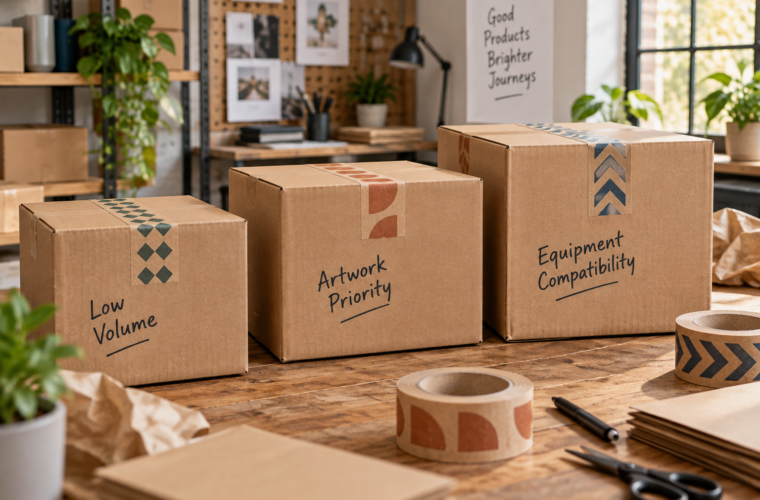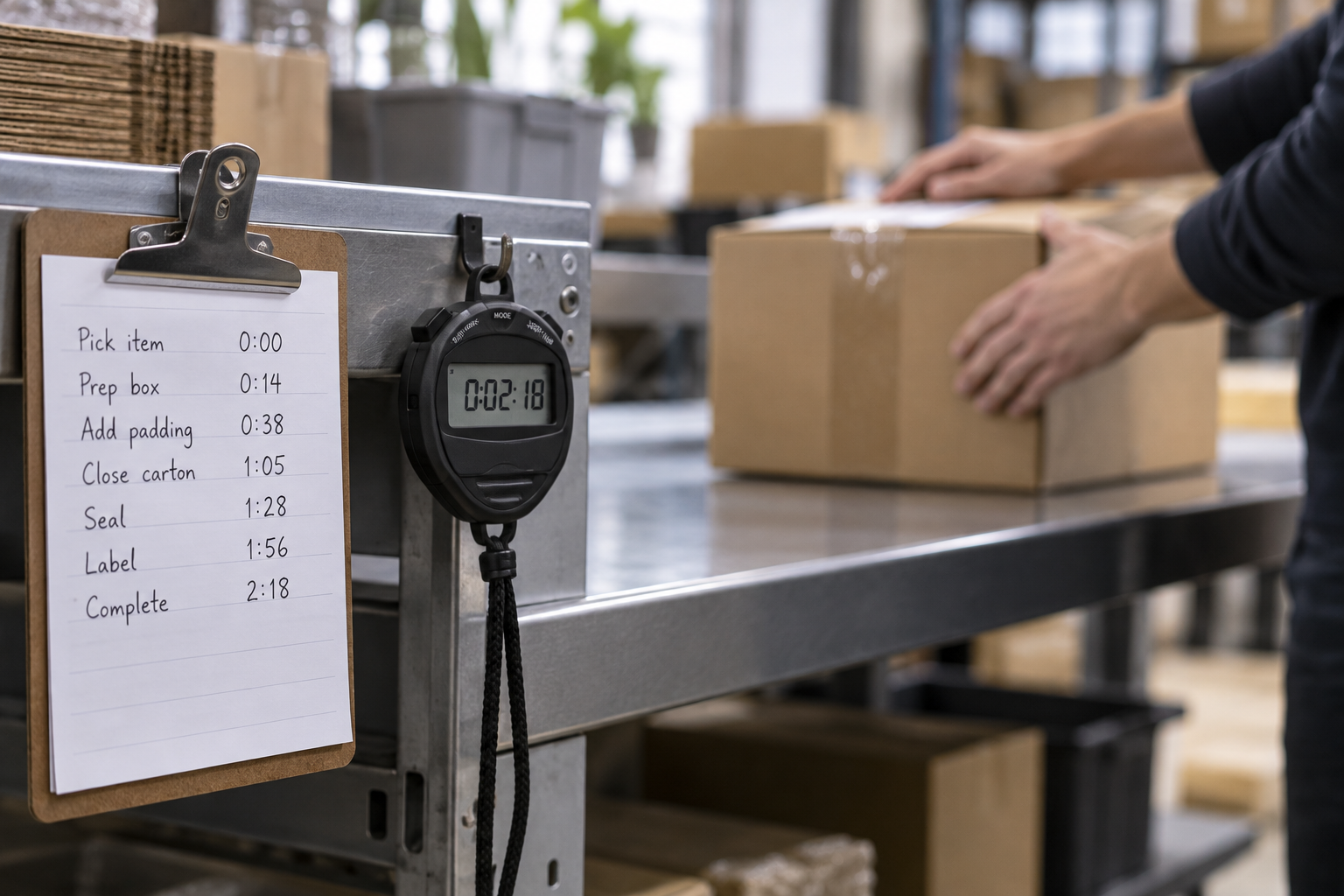
AI-generated editorial illustration, not a product test or customer case. Any displayed timings are illustrative, not measured results.
A cheaper roll can still require more of the packing team’s time. But an equipment brochure’s speed figure will not tell you the labor cost of your own order mix.
To compare packing tape labor cost, start by deciding which part of the job you are timing. Reaching for the tape, preparing a strip, applying it and putting the carton aside are different from picking products or printing labels.
Draw the boundary before starting the clock
Write a clear start and finish for the observation. You might observe tape preparation through completed closure, while recording carton assembly and labeling separately.
Use the same boundary for each option. Comparing one tape’s application time with another option’s entire packing cycle creates a misleading result.
Also record setup and cleanup. A short session can be affected by these fixed tasks even when the closure step itself is straightforward. Do not quietly exclude them from one option and include them in another.
Separate three kinds of time
Routine work
This is the repeated action on ordinary cartons under the arrangement being observed. Note the carton types and which closure instructions apply.
Change and preparation
Installing a roll, preparing equipment and changing between designs may happen less often, but they still use time. Record them separately so you can relate them to the batch that required them.
Interruptions and rework
A missing shipping label is not automatically a tape problem. A strip that needs replacing may be relevant, but the cause still needs investigation. Name the interruption rather than allocating every delay to the material.
This separation gives you something to improve. A single average hides whether the problem is setup, movement around the bench or the closure itself.
Do not turn the observation into a race
Tell the person packing that the aim is to understand the process, not to demonstrate a target speed. Keep the required order checks and safe equipment use in place.
Record whether the operator is familiar with the setup. Learning a new application method and repeating an established routine are different conditions. If the order mix changes, keep that context with the result.
This is a practical costing observation, not a standardized performance test. It does not establish a universal cartons-per-hour claim.
Convert a measured input into a cost
Use the business’s own appropriate labor-cost input. If closure time is recorded in seconds, dividing by 3,600 converts it to hours. Multiply that time by the chosen hourly cost.
Keep preparation time visible at batch level before allocating it across the cartons actually handled. State which tasks the estimate includes. If an hourly figure is not available, report the time rather than inventing a currency amount.
The resulting estimate belongs in your existing cost-per-box worksheet alongside tape consumption and other relevant costs.
Compare a workable configuration
Before measuring water activated packing tape, confirm that the proposed roll and application setup are compatible. BrandTapeCo’s confirmed online widths are 48 mm and 60 mm; core size and finished roll diameter remain questions when the equipment requires them.
Do not recommend one material solely because a brief observation looks faster. Carton suitability, closure quality, artwork and the complete cost still matter. Keep the result attached to the configuration you actually observed so the next purchasing decision can be checked.
Frequently Asked Questions
Can I use a dispenser's advertised speed as my labor estimate?
It is not a measurement of your packing process. Document your own task boundary and operating conditions.
Should setup time be included?
Record it separately and allocate it transparently where relevant to the comparison.
Does this method prove one tape is faster everywhere?
No. It produces observations for your own configuration and workload, not a universal performance ranking.