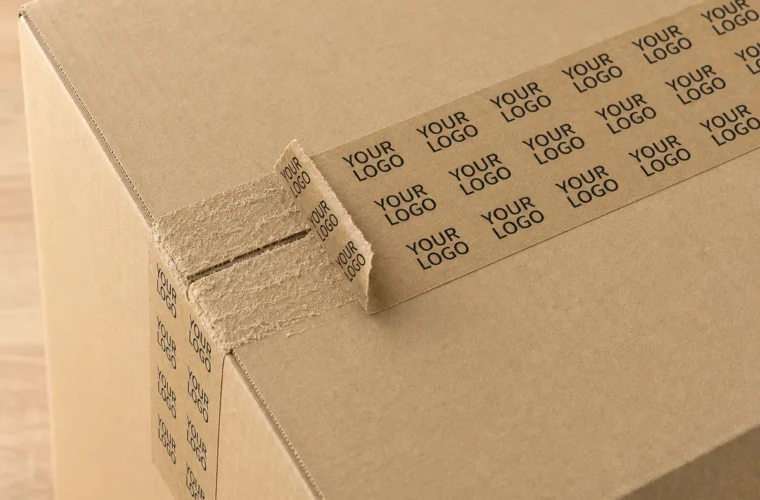
A kraft-paper tape may be accurately described by its verified material construction, but that does not automatically make “recyclable,” “plastic-free,” “compostable,” or “eco-friendly” accurate. Each statement needs its own evidence and a defined market. If documentation for the exact printed tape is unavailable, remove the stronger claim rather than filling the gap with reassuring language.
Do not combine unlike claims
| Proposed wording | What must be checked first |
|---|---|
| Paper-based or kraft-paper backing | Supplier documentation for the actual backing and complete product description. Make clear which component the wording describes. |
| Recyclable with corrugated boxes | Evidence for the tape-and-box use case and guidance from the intended local collection or recycling stream. |
| Plastic-free | A component-level review of backing, adhesive, reinforcement, inks and coatings. A paper backing alone is insufficient. |
| Compostable or biodegradable | Product-specific evidence, applicable standard or facility conditions, and the exact scope of the claim. |
| Lower impact or eco-friendly | A clearly defined comparison and supporting data; avoid a vague overall environmental superiority statement. |
The table is a review framework, not a certification of BrandTapeCo products. This article does not provide test results, recycling acceptance, life-cycle data or legal approval for any of those claims.
Approval workflow before a claim reaches packaging or a listing
- Copy the exact sentence. Save the label, website or sales wording as it will appear to customers; vague paraphrases hide overclaims.
- Name the configuration. Record kraft or reinforced kraft construction, 48 mm or 60 mm width, approved printed artwork, adhesive and any relevant finish. Do not transfer evidence from an unprinted or different tape without checking its scope.
- Attach the evidence. Keep the issuing organization, method, date, tested sample, limitations and destination market with the claim approval.
- Ask the local reviewer. Recycling and marketing requirements depend on where the package is sold and discarded. Have a qualified reviewer check both the underlying evidence and the proposed wording for that market.
- Publish only what is supported. If evidence is absent or incomplete, use a narrower verified material description or omit the environmental statement.
Examples of safer editorial decisions
If you can verify only that the backing is kraft paper, say exactly that and avoid claiming the entire printed tape is recyclable. If a recycler’s document applies to one specific construction and locality, do not rewrite it as a universal claim. If a supplier offers a sample, use it for artwork and carton-application review, not as a proxy for environmental certification.
For a document-by-document supplier request, see what recyclability evidence to request. For orderable tape options, see the custom water-activated tape product page. Standard online orders use 50 m rolls and at least five rolls per design and color configuration; any nonstandard roll length needs a sales feasibility assessment and separate written quote, with no guarantee it can be made.