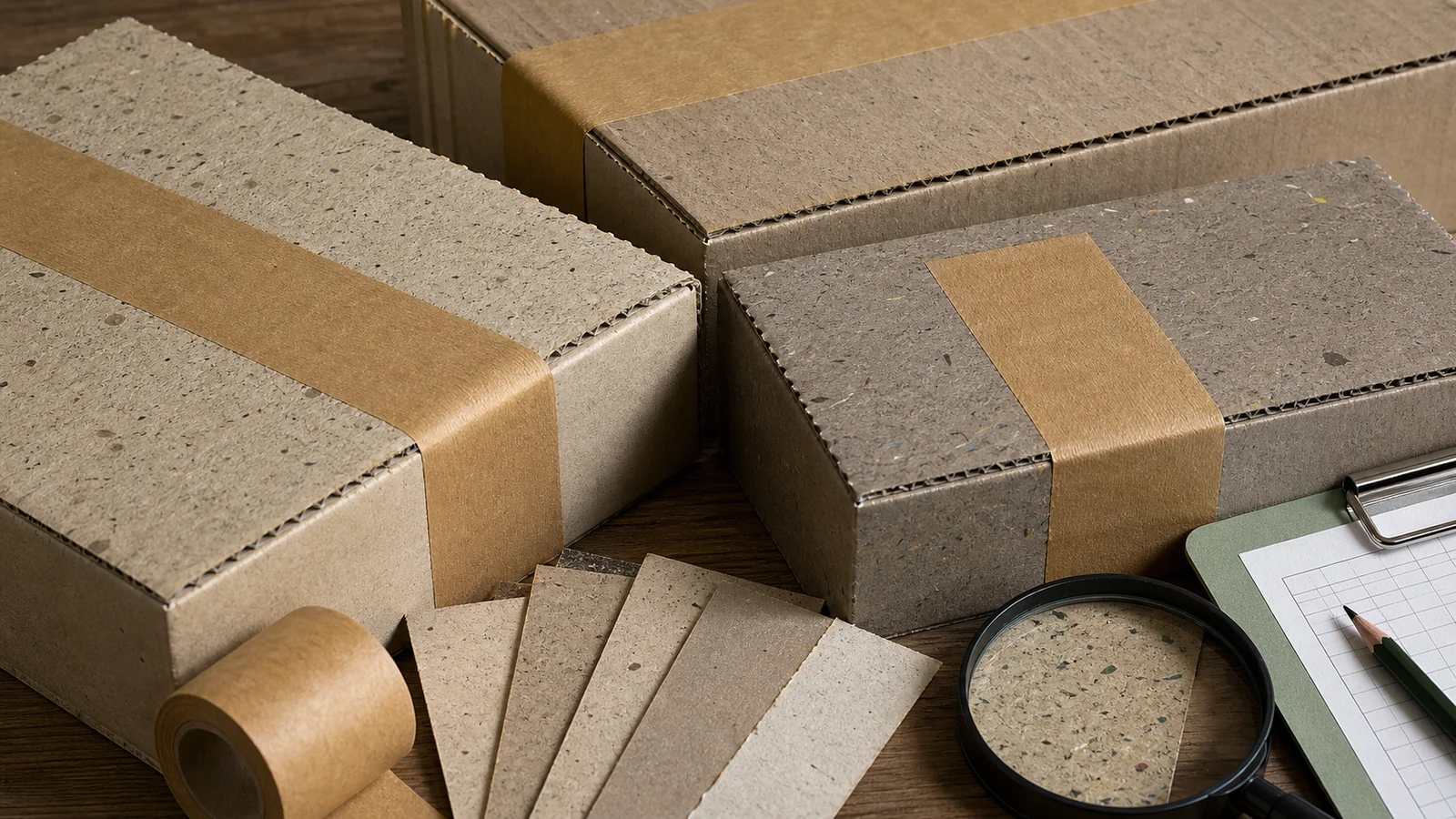
Recycled-content corrugated cartons are not one uniform surface. Board source, surface treatment and the condition of a specific carton can change, so choose tape with a trial on your real boxes—not with an assumption that all recycled board will seal the same way. A successful application test also does not prove that the tape-and-box package is recyclable in every local system.
This recycled-corrugated-box guide concerns water-activated (gummed) tape from suppliers of that category. BrandTapeCo instead supplies self-adhesive kraft paper and reinforced kraft paper tape, applied without water. The water-activated application and dispenser references in this guide do not apply to BrandTapeCo tape; test each product using its own supplier-approved application method.
Collect representative board samples
Identify the carton supplier or board grade, the box sizes used most often, and any variant that previously showed sealing problems. Keep a sample from each relevant board batch where possible. Note whether the test box has dust, surface coating, crushed folds or other visible differences. Record these details before changing tape construction or dispenser settings.
Control the sealing trial
- Choose the real configuration. Record the water-activated supplier’s exact product, construction and offered width. Check the candidate against the actual seam and dispenser. BrandTapeCo’s self-adhesive kraft and reinforced kraft paper options are a separate alternative in 48 mm and 60 mm widths only.
- Use a repeatable method. Follow the dispenser manufacturer’s activation and application instructions. Keep the operator process consistent across carton samples.
- Observe more than initial appearance. Record whether the tape fed, cut and lay flat; where any lifting or board damage appears; and when the observation was made. Include a photo of the seam and the board identification.
- Compare changed variables separately. If a new board fails while an earlier board seals acceptably, test the board change before assuming the tape specification is defective. If the process changes, rerun the comparison.
For a structured worksheet, see the corrugated carton compatibility test. If the issue appears at the dispenser or only on one shift, use the application troubleshooting guide to separate station variables.
Keep recycling claims separate from seal performance
A board described as “recycled content” says something about its inputs, not whether the finished package will be accepted by a recycler. The tape’s backing, adhesive, reinforcement and ink all need review for a claim about recyclability. Request product-specific evidence and check the rules where the package will be discarded; do not infer a certificate from a seal trial. The recyclability evidence guide lists the documents to request.
When the trial becomes an order
For the self-adhesive alternative, BrandTapeCo supplies kraft paper and reinforced kraft paper tape that applies without water. Carry the selected board, tape material, width and approved artwork into the purchase record. Standard online custom tape is 50 m per roll and starts at five rolls per design and color configuration. No other custom width, including 72 mm, is available. A nonstandard roll length is only a sales feasibility question with a separate written quote, not a guaranteed option. Check the current product listing for the live order configuration.