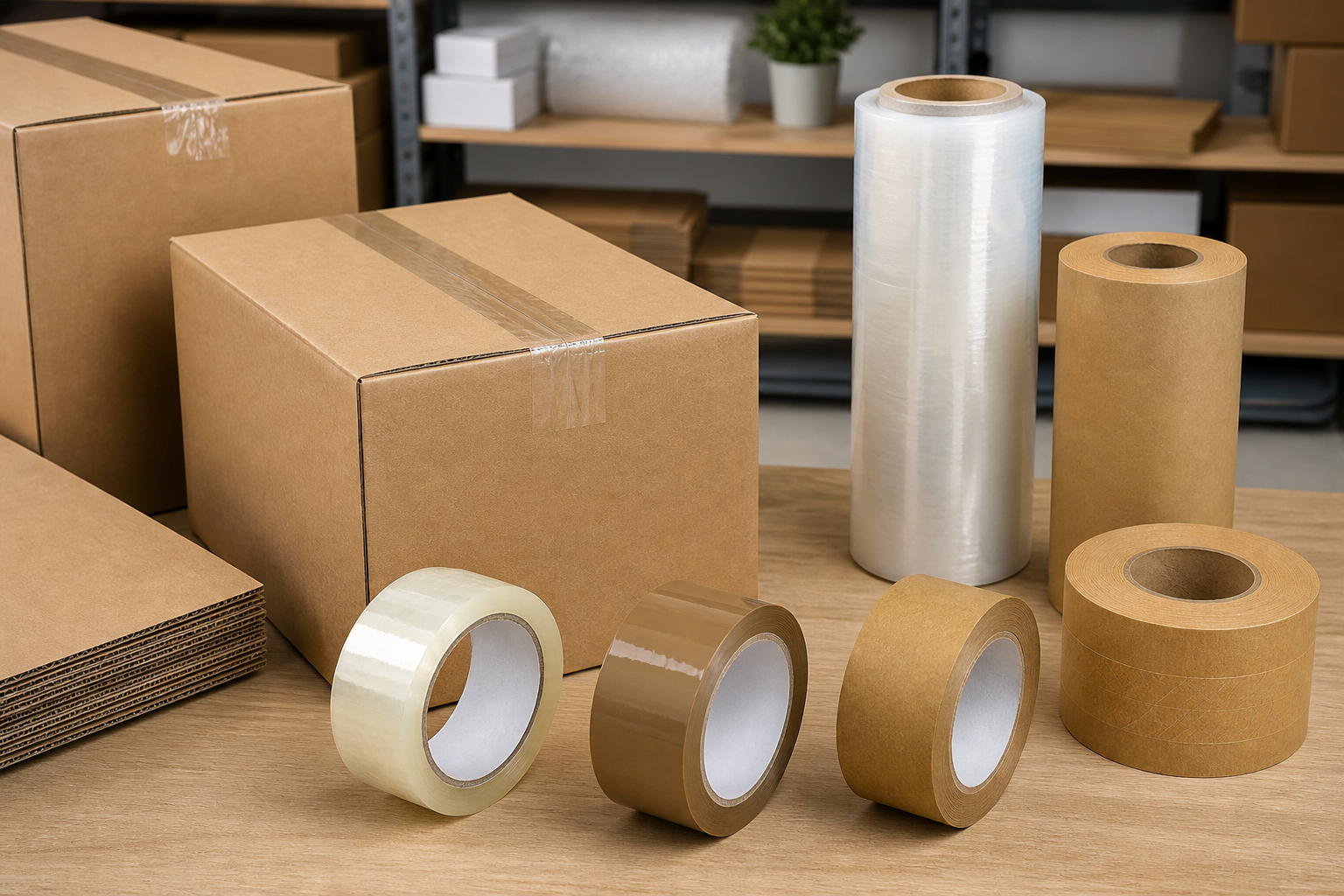
The terms mailing tape, packing tape, packaging tape, and shipping tape are often used interchangeably. That is usually harmless in everyday conversation. It becomes a problem when a buyer assumes the label describes a specific backing, adhesive, width, or application method.
The practical answer to mailing tape vs packing tape is simple: the names describe intended use more often than a controlled product specification. For a reliable carton closure, buyers need to look beyond the name on the listing.
Quick Comparison of the Terms
| Term | What people usually mean | Where ambiguity appears |
|---|---|---|
| Mailing tape | Tape used to prepare a parcel or mailer for shipment | May refer to carton-sealing tape, paper tape, or light-duty office tape |
| Packing tape | General tape for closing boxes during packing | Does not identify backing, adhesive, or performance level |
| Packaging tape | Broad category covering tapes used in packaging | Can include carton sealing, bundling, masking, coding, and specialty formats |
| Shipping tape | Tape intended to keep a parcel closed through distribution | Still does not guarantee a specific construction or carton compatibility |
In many online listings, packing tape and shipping tape point to the same pressure-sensitive carton-sealing product. “Packaging tape” is broader. “Mailing tape” is the least precise because it can describe anything used on a mailed item.
Mailing Tape vs Packing Tape: Are They the Same?
Sometimes. If a seller uses “mailing tape” for a roll designed to close corrugated boxes, it may serve the same basic job as packing tape. But the name alone is not enough to make that decision.
A narrow transparent tape meant for envelopes is not automatically suitable for a heavy corrugated carton. Decorative paper tape may look appropriate on a parcel but may not be intended as the primary closure. Conversely, a purpose-built carton-sealing tape may be marketed under any of the four terms.
Before treating the products as equivalent, check:
- intended substrate, especially corrugated fiberboard;
- backing material and reinforcement, if any;
- pressure-sensitive or water-activated application;
- width and roll length;
- compatible dispenser;
- storage and application guidance;
- supplier testing or sample options.
Packaging Tape vs Packing Tape
“Packaging tape” names a category. “Packing tape” usually names a familiar use within that category.
This distinction matters when a procurement request says only “packaging tape.” One department may picture clear pressure-sensitive film tape. Another may expect printed paper tape. A third may be sourcing a specialty tape for bundling rather than carton closure.
If the tape will close shipping boxes, write that job into the request: carton-sealing tape for corrugated boxes. Then add the construction and application requirements. The packaging tape roll specification checklist provides a useful set of fields for comparing products.
Packaging Tape vs Shipping Tape
Shipping tape is usually a use-based label for packaging tape expected to remain on the parcel through transportation. However, “shipping” does not tell you how the tape creates a bond.
Two common systems work differently:
- Pressure-sensitive tape bonds when adhesive contacts the surface and pressure is applied.
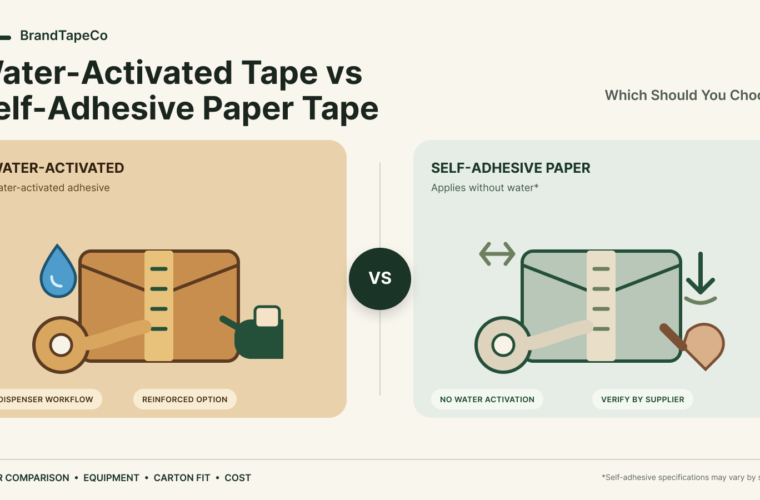
- Water-activated tape uses moisture to activate a dry adhesive before the tape is pressed onto corrugated board.
Neither system should be selected from terminology alone. Carton surface, dust, recycled content, temperature, packed weight, route, and operator workflow can all affect the choice. A focused water-activated tape vs BOPP tape comparison helps buyers compare those systems without relying on the word “shipping.”
What to Specify Instead of a Generic Tape Name
Use a short specification that another person could reorder without guessing.
| Specification field | Example of the decision to record |
|---|---|
| Job | Primary closure for corrugated shipping cartons |
| Application | Hand-applied pressure-sensitive or dispenser-applied water-activated tape |
| Backing | Paper, reinforced paper, or film, as verified by the supplier |
| Dimensions | Required width and roll length |
| Cartons | Board surface, sizes, packed weights, and demanding cases |
| Environment | Packing, storage, and shipping conditions to evaluate |
| Printing | Unprinted or custom printed; artwork and proof requirements |
| Commercial terms | Quantity, destination, price basis, freight, and timing |
BrandTapeCo’s product page, for example, identifies its custom kraft paper packing tape as water-activated paper tape for corrugated cartons. It lists standard and reinforced kraft options, 1.89 in (48 mm) and 2.36 in (60 mm) widths, and one-color, two-color, or full-color printing. Those details are more useful than a generic “mailing tape” label.
A Practical Buying Example
Suppose an ecommerce team asks for “branded mailing tape.” The buyer should translate that phrase into questions:
- Is the tape the primary closure for the outer box or decoration for an inner mailer?
- Are the outer cartons corrugated, coated, dusty, or highly recycled?
- Will operators use handheld dispensers or water-activated equipment?
- What widths fit the carton seams?
- Is the artwork a repeating logo, a message, or both?
- How many rolls are needed, and where will they be delivered?
The resulting specification may point to custom printed carton-sealing tape. It may also reveal that ordinary packing tape plus a label is sufficient. The terminology should not decide the purchase before the packaging job is defined.
Frequently Asked Questions
Can mailing tape be used on boxes?
Only if the specific product is intended and tested for the carton, load, application, and shipping conditions. “Mailing tape” by itself is not a performance specification.
Is packaging tape stronger than packing tape?
Not necessarily. Packaging tape is a broad category name, so strength depends on the actual construction and use conditions.
Is shipping tape different from clear packing tape?
Many sellers use both names for the same pressure-sensitive film tape. Check the product data rather than assuming the labels establish a difference.
What tape information belongs on a purchase order?
Record the application, backing, adhesive or activation method, dimensions, dispenser, printing, quantity, destination, and approved product reference.
Should custom printed tape be called mailing tape?
It can be, but “custom printed carton-sealing tape” is clearer when the product closes corrugated shipping boxes.
Use the Term That Matches the Specification
A purchase order should not rely on “mailing,” “packing,” or “shipping” as the complete product description. Name the backing, adhesive or activation method, width, roll length, printing, dispenser requirement, and cartons the tape must close.
When water-activated printed paper tape matches that specification, the next useful step is a test on the boxes and equipment the packing team actually uses.