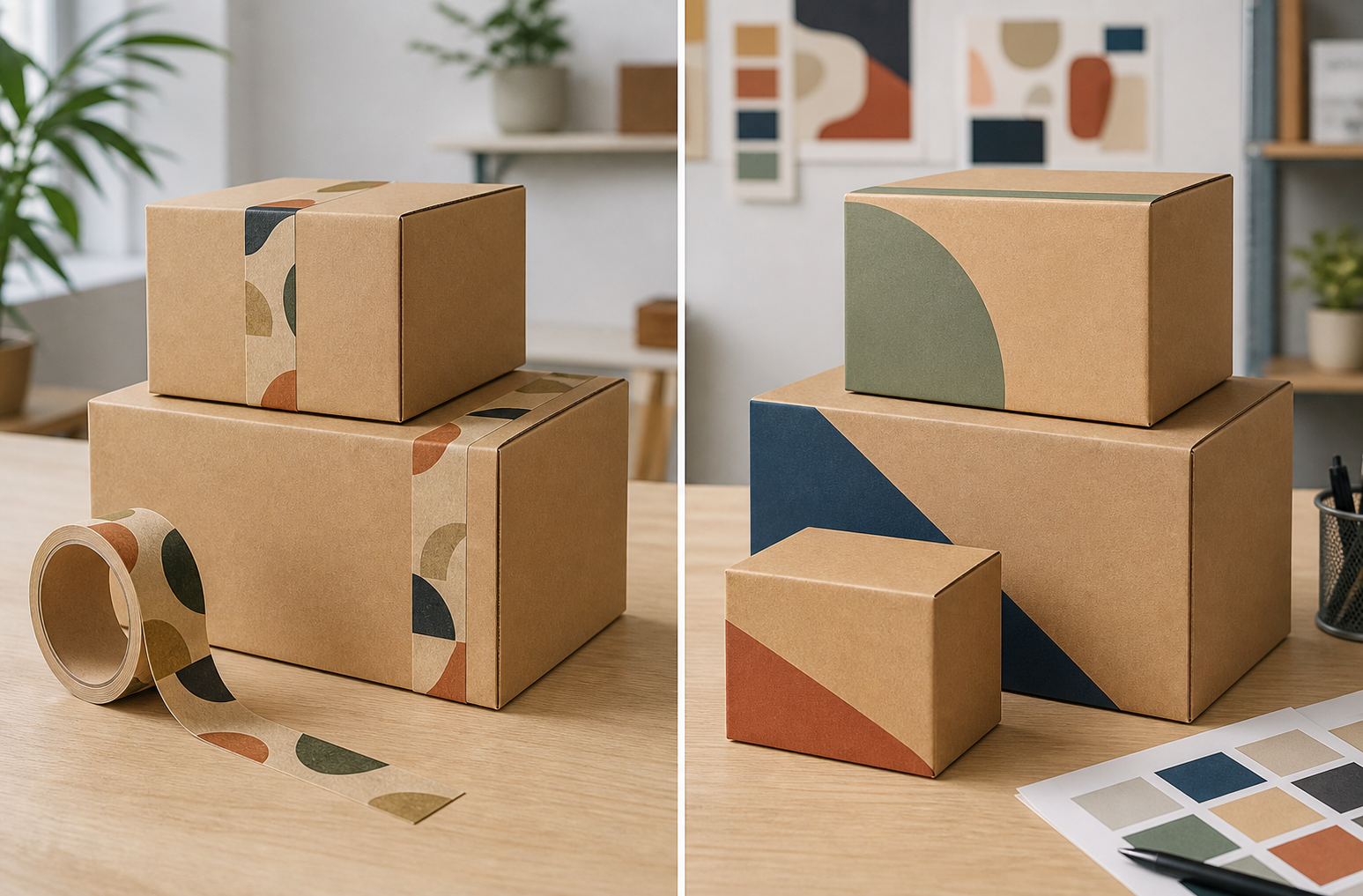
Custom packing tape and custom printed boxes can both place a brand on the outside of a shipment, but they create very different inventory commitments. Printed boxes assign artwork to a specific carton. Printed tape applies artwork while performing the closing step and can often be used across multiple plain-carton sizes.
The right choice is not simply the cheaper item. A useful custom packing tape vs custom printed boxes comparison looks at total applied cost, SKU complexity, design lifespan, packing speed, and the job each component must perform.
The Decision at a Glance
| Decision factor | Custom packing tape on plain boxes | Custom printed boxes |
|---|---|---|
| Branding location | Repeating band across the carton seam | Artwork can cover selected box panels |
| Inventory | One tape design may serve several carton sizes | Each printed carton size is a separate inventory item |
| Design change | Change tape on the next approved roll order | Existing printed cartons retain old artwork |
| Packing step | Branding is added during closure | Branding is already on the box |
| Visual impact | Concentrated along the seal | Larger canvas and more structural design options |
| Procurement question | Tape construction, dimensions, printing, dispenser, quantity | Board, style, dimensions, printing, quantity, storage |
Neither format is universally better. The box still has to contain and protect the order, and the tape still has to close the carton under the intended conditions.
Compare Total Applied Cost, Not Unit Price
A tape roll and a printed box use different units, so a direct unit-price comparison is misleading. Build a cost model around completed shipments.
For custom tape, include:
- tape price and roll length;
- tape used per carton, including waste;
- dispenser and maintenance costs where applicable;
- artwork, proof, freight, and storage;
- packing labor or workflow changes.
For printed boxes, include:
- unit price by box size and style;
- plates, tooling, setup, or artwork charges if quoted;
- inbound freight and storage space;
- damage, obsolescence, and leftover inventory;
- the cost of stocking multiple sizes.
Do not publish savings until both suppliers quote the same planning period and shipment volume. The custom tape quote factors guide identifies the fields that can change a tape inquiry.
Inventory Flexibility Often Favors Tape
An ecommerce brand using four plain-carton sizes may be able to seal all four with one approved tape design, provided the construction and width work across the carton range. This reduces the number of branded packaging SKUs.
That flexibility is useful when:
- order volume is split across many carton sizes;
- product assortment changes frequently;
- the brand is still refining its visual identity;
- campaigns require temporary artwork;
- storage space is limited.
It is not automatic. Different seams, board surfaces, packed weights, or routes may require different tape configurations. The custom tape for mixed carton sizes guide explains how to test representative carton groups before standardizing.
Printed Boxes Offer a Larger Design Canvas
Printed boxes can carry larger illustrations, panel-specific instructions, interior printing, product storytelling, and more controlled placement than a repeating tape strip. For a stable, high-volume packaging system, that canvas may justify the added carton inventory.
Printed boxes are especially attractive when:
- one or two carton sizes dominate volume;
- packaging graphics need precise panel placement;
- the box structure is part of the product presentation;
- artwork is expected to remain stable through the inventory cycle;
- storage and replenishment are already controlled.
The brand still needs closure tape unless the package uses another approved closure system. Printed boxes and custom tape are not always substitutes; they can be layers in the same packaging stack.
Think About Artwork Lifespan
Before committing either format, estimate how long the artwork will remain usable.
| Artwork element | Obsolescence risk |
|---|---|
| Core logo | Usually lower if the identity is stable |
| Website domain | Moderate if migrations or rebranding are possible |
| Social handle | Higher if platform strategy changes |
| Seasonal message | High after the campaign ends |
| Promotion or coupon | High when the offer expires |
| Regulatory or handling copy | Must be controlled and reviewed for the actual use |
Tape can isolate temporary branding from the carton. Printed boxes may be preferable when the entire structural presentation is evergreen. A hybrid system can use a mostly evergreen printed box plus campaign tape, or a plain box plus branded tape and an internal insert.
Workflow and Packing-Speed Considerations
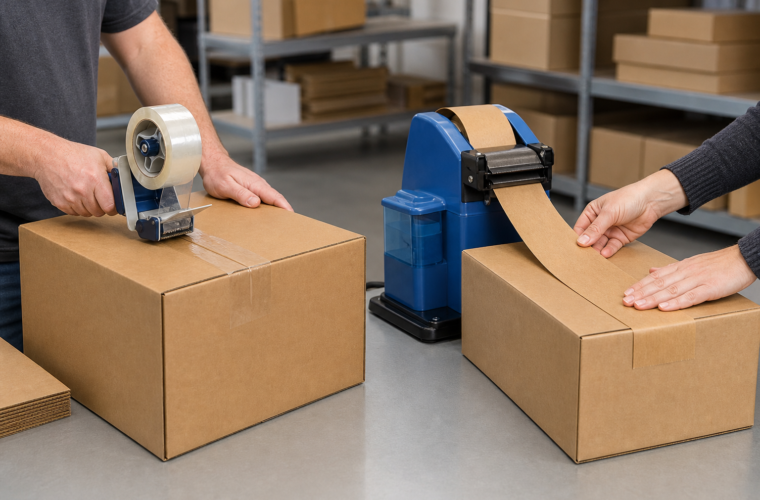
Printed boxes arrive branded, but they require the correct printed SKU at the station. Custom tape adds branding during a step the packer already performs, although a new application system may require equipment and training.
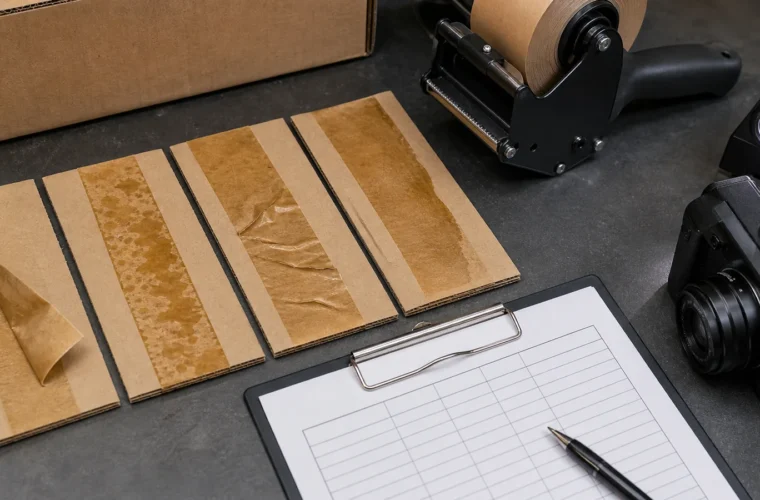
Test both options in the real workflow:
- stage representative orders and carton sizes;
- measure the complete packing sequence, not one isolated action;
- record picking errors, changeovers, waste, and operator questions;
- check the finished parcel for closure and presentation;
- repeat under realistic peak volume.
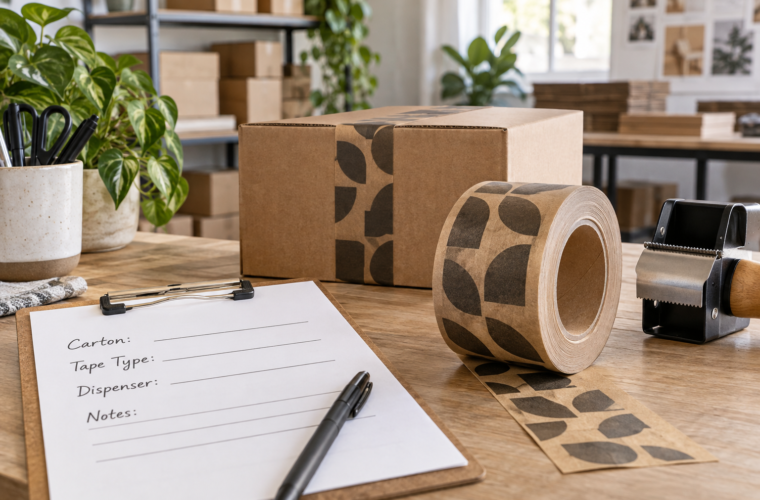
The ecommerce packaging supplies guide can help teams document the approved pack instead of relying on memory.
When a Hybrid Approach Makes Sense
A hybrid approach is often more practical than choosing one branded surface for every shipment.
Examples include:
- printed mailer boxes for a flagship subscription and plain cartons with branded tape for irregular orders;
- custom printed boxes for retail presentation, plus tamper-visible branded tape on the outer shipper;
- plain cartons for year-round fulfillment, with seasonal tape during a campaign;
- printed boxes for the dominant size and tape for low-volume oversize cartons.
The Shopify branded packaging checklist helps assign each packaging item a distinct job.
Where BrandTapeCo Fits
BrandTapeCo sells custom printed water-activated kraft paper tape for corrugated cartons. Current options include standard or reinforced kraft paper, 1.89 in (48 mm) and 2.36 in (60 mm) widths, a 164 ft (50 m) roll length, and one-color, two-color, or full-color printing. The product page lists a minimum order of five rolls and requires approval of a digital production proof.
Those details make it possible to model an initial tape test. They do not prove tape is cheaper than printed boxes for every operation. Buyers should compare order-specific quotes, freight, consumption, storage, and workflow.
Frequently Asked Questions
Is custom packing tape cheaper than custom printed boxes?
It can reduce branded carton SKU commitments, but the answer depends on quotes, tape consumption, box mix, freight, storage, equipment, and labor. Compare cost per completed shipment.
Can one custom tape design work on every box size?
Possibly, but test width, application, appearance, and closure on representative carton groups before standardizing.
Do printed boxes still need packing tape?
Many corrugated shipping boxes still require an approved closure. The printed surface does not replace the structural closure decision.
Which option is better for seasonal campaigns?
Tape may limit temporary artwork to one inventory item, while printed boxes offer more design space. Model leftover inventory before choosing.
Can a brand use both?
Yes. A printed box and branded tape can serve different presentation, closure, or campaign roles.
Make the Choice at the Shipment Level
Run the comparison against a representative month of shipments, not a single unit price. Include the actual box mix, tape consumption, storage space, labor, freight, artwork lifespan, and leftover inventory. That will show whether the operation needs one flexible branded closure, a larger printed canvas, or a combination of both.
If tape is the better first test, use the confirmed BrandTapeCo options to build a carton-specific sample rather than assuming one configuration will fit every box.
Compare a Custom Tape Configuration
If a flexible branded closure fits the box mix, review the current online tape configurations before approving a test order.
Next step: review custom printed packing tape options for current configurations and order-specific details.