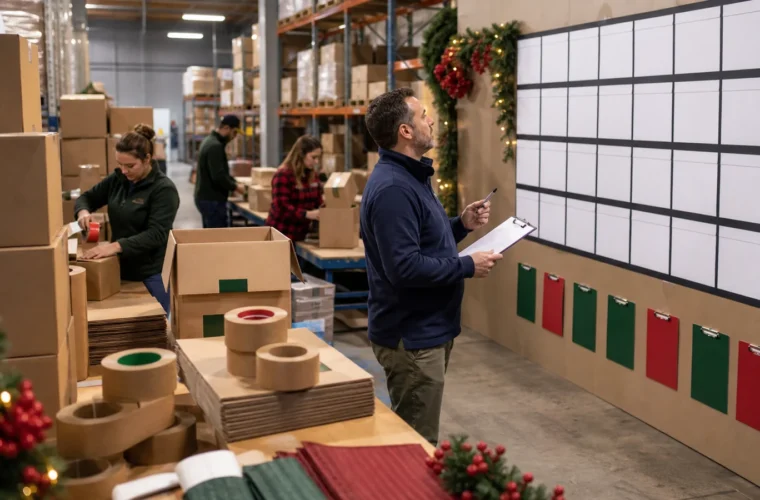
The first few orders can be packed from memory. By order fifty, memory starts costing time: somebody reaches for the wrong box, the approved logo file is buried in a message thread, or tape runs out halfway through a promotion. That is the point at which packaging stops being a styling exercise and becomes a small supply system.
According to the U.S. Census Bureau's Quarterly Retail E-Commerce Sales report, seasonally adjusted U.S. retail e-commerce sales were estimated at $326.7 billion in the first quarter of 2026. That was 9.8% (±1.8%) above the first quarter of 2025, and e-commerce represented 16.9% of total retail sales. The estimate was not adjusted for price changes.
These figures describe retail sales, not packaging consumption, Shopify-only sales, or BrandTapeCo demand. For an individual seller, the useful planning unit remains the shipment: pick the product, protect it, close the pack, label it, dispatch it, and replace the materials used.
Packaging Becomes Infrastructure After the First Few Orders
At launch, a founder may pack each order personally and treat packaging as a creative project. As volume grows, undocumented choices create familiar problems:
- the correct box runs out;
- a substitute tape behaves differently;
- logo files cannot be located;
- operators apply decorative materials inconsistently;
- a reorder starts too late;
- an environmental statement cannot be supported; or
- the brand experience changes from one shipment to the next.
The fix is mostly administrative: decide which materials are approved, who owns the stock count, where the artwork lives, and what evidence supports any claim printed on the pack.
Buy the Shipping Basics Before the Brand Extras
Start with the materials needed to ship the actual product:
- Primary protection: product-specific wrap, insert, divider, cushioning, or another validated protection method.
- Shipping container: a suitable mailer or corrugated carton.
- Closure: an approved carton-sealing tape or closure system.
- Carrier information: the correct shipping label and any required documentation.
Once that pack works, add brand elements where they will be seen and applied consistently:
- logo-printed carton tape;
- branded tissue paper;
- stickers or inner seals;
- thank-you cards or instructions;
- QR destinations;
- personalized boxes; or
- restrained color and pattern choices.
Shopify's small-business packaging ideas include personalized bags and boxes, custom tape and stickers, tissue paper, inserts, and other brand elements. Shopify does not require this shopping list. A candle maker, a clothing brand, and a parts distributor will make different choices because their products, shipping risks, workflows, and budgets differ.
Make the Outer Closure Work Harder
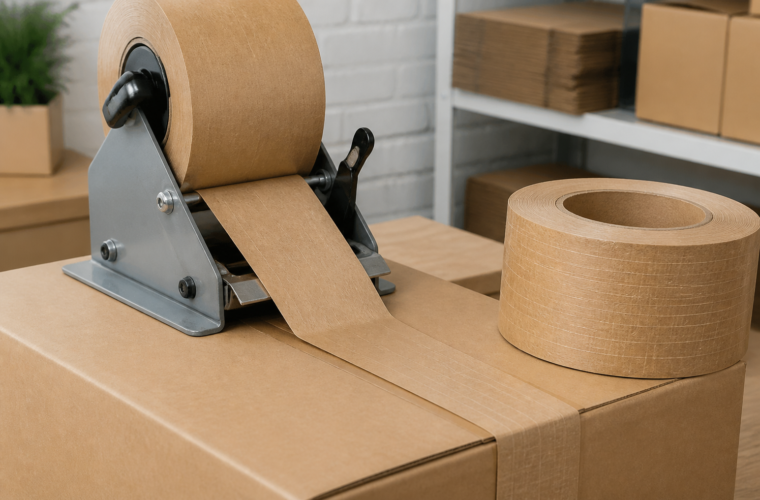
For brands shipping corrugated cartons, the closure is already a required step. Custom kraft paper tape can turn that step into a visible brand element without adding a separate exterior sticker operation.
BrandTapeCo confirms kraft paper and reinforced kraft paper options, water-activated adhesive, widths of 1.89 in (48 mm) or 2.36 in (60 mm), and one-color, two-color or full-color custom printing. The standard online minimum is five 50 m rolls per design and color configuration. Ask about sample availability for a particular order. Production typically takes 5–7 business days after proof approval, with shipping separate; volume terms require a written quote.
The order inquiry still needs to cover roll length, core size, volume-order MOQ, pricing, paper grade, reinforcement material, dispenser compatibility, print method, ink, packaging units, storage conditions, certification, delivery timing, load data, stock, and any proposed environmental claim. BrandTapeCo has not confirmed universal values for these items.
Do not turn “paper-based” into “100% recyclable,” or possible visible seal disturbance into “tamper-proof.” Ask for the exact construction and evidence before those words reach a product page or pack.
Five Records That Keep the Packing Bench Moving
Record 1: The approved pack specification
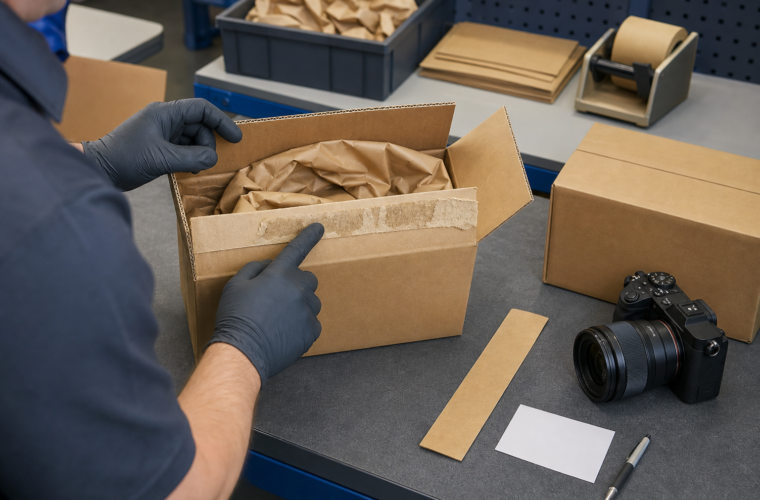
For each product family, record the inner protection, box or mailer, closure method, label placement, insert, and exceptions. A quick phone photo can be more useful than another paragraph of instructions, provided the current version is clearly dated.
Record 2: The artwork and proof register
Store the master logo, color references, tape layout, proof version, approval date, and approver together. Reusing a logo does not mean reusing the same production file: tape, stickers, tissue, and inserts can require different repeats, bleeds, detail, and color handling.
Record 3: The application test
Test the proposed closure on representative cartons using the intended operator method. Write down the carton supplier and surface, tape sample, dispenser or activation method, placement, observation time, visible application issues, and approval decision. Set acceptance rules for the actual pack instead of borrowing an unexplained universal threshold.
Record 4: The consumption and reorder log
Measure normal use rather than relying on a generic cartons-per-roll claim. Track beginning inventory, receipts, issued rolls, exceptions, and shipment volume. Reorder timing should consider actual use, open purchase orders, artwork changes, supplier response, destination, and peak periods. Fixed lead time is not confirmed.
Record 5: The claim-evidence file
Keep bills of materials, supplier declarations, certificates, scope statements, test reports, revision dates, and location-specific disposal guidance together. A kraft-paper appearance, on its own, does not support “recyclable,” “plastic-free,” “fully compostable,” or “tamper-proof.”
A 30-Order Packaging Audit
Before commissioning a full redesign, audit a manageable batch of fulfilled orders. Thirty is a useful working example, not a required test size.
Before packing: select representative products, carton sizes, operators, and destinations. Record the approved materials.
During packing: note substitutions, wasted movements, unclear instructions, tape activation or placement issues, and missing supplies. Avoid timing claims unless the observation method is defined.
After dispatch: review damage reports, opening feedback, carrier exceptions, remaining stock, and artwork consistency. A customer comment is feedback, not a controlled performance test.
At the decision meeting: keep, change, test, or remove each packaging layer. Assign an owner and evidence requirement to every change.
Questions for a Custom Paper Tape Inquiry
A supplier can give a more useful answer when the inquiry describes the packing job. Bring these inputs instead of asking for a generic “best tape”:
- What corrugated cartons are being sealed?
- Are their surfaces recycled, printed, coated, dusty, or variable?
- What is the packed-weight range?
- Which routes and handling conditions matter?
- How many cartons are packed normally and at peak?
- Is application by an existing dispenser or another method?
- Which tape width and roll constraints must be reviewed?
- Is standard or reinforced kraft paper under consideration?
- What logo file and print approach are proposed?
- What must the sample validate?
- What quantity estimate, destination, and target date should the supplier review?
Frequently Asked Questions
Which ecommerce packaging supplies are essential?
The essential set depends on the product, but it normally covers protection, a suitable shipping container, an approved closure, and carrier information. Tissue, stickers, inserts, custom printing, and other brand layers are optional unless they serve a defined product or communication requirement.
Should a small brand customize boxes or tape first?
There is no universal order. If the business already ships plain corrugated boxes, logo-printed sealing tape may brand a required workflow step. Compare artwork, inventory, packing labor, box-size variation, MOQ and supplier terms before deciding.
Does BrandTapeCo offer a 5-roll minimum for custom paper tape?
Online ordering starts at 5 rolls per selected configuration; volume-order minimums depend on the reviewed enquiry. Provide material, width, printing, artwork, quantity estimate, sample request and destination for an order-specific response.
Can ecommerce sales statistics predict my packaging needs?
No. Market statistics provide context but do not replace your order, carton and material data. Forecast packaging from the brand’s actual shipments, promotions, product mix, substitutions, waste, open orders and peak plans.
Is paper packing tape automatically recyclable?
No. The final paper, adhesive, reinforcement, ink, coatings and local recycling rules all matter. Obtain product-specific evidence before using a recyclability statement.
Build for the Next Reorder, Not Just the Next Unboxing
Professional ecommerce packaging combines protection, brand recognition, operator clarity, evidence, and replenishment. If your operation ships corrugated cartons, BrandTapeCo can review a custom water-activated tape request using your actual carton, artwork, width, quantity estimate, sample objective, application method, destination, and target date.
Plan Your Custom Packaging Tape
Next step: see custom packing tape for small orders for current configurations and order-specific details.