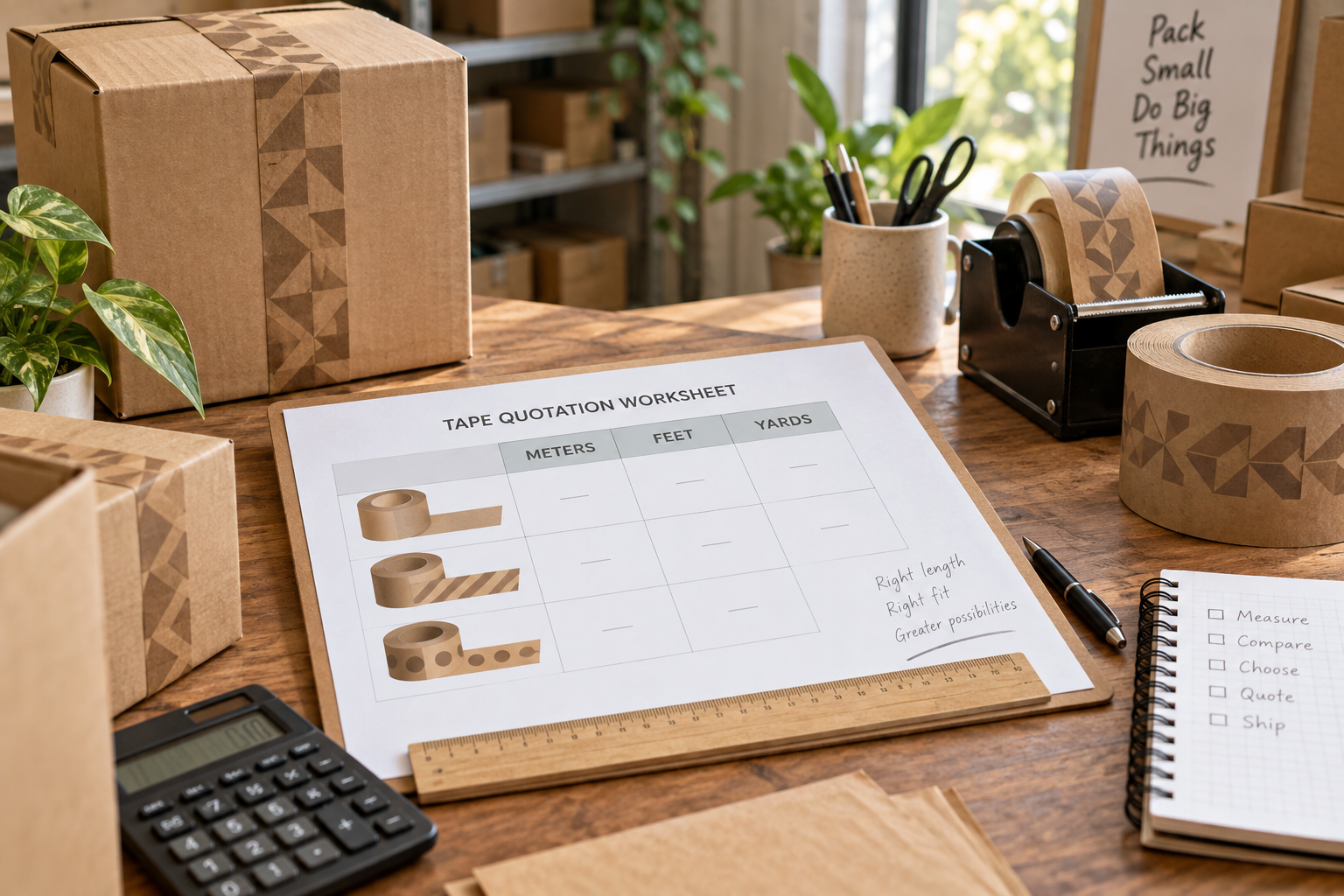
One custom tape quotation lists meters, another feet, and a third yards. Comparing the price beside each roll without converting the length can make the shorter offer look better than it is.
Short answer: Put every quotation into one unit before comparing roll quantity or price. Then calculate total supplied length and cost per foot or meter.
Use one conversion throughout the worksheet
One foot equals 0.3048 m. One yard equals 0.9144 m. Convert the stated roll length first, then divide the roll price by that length.
For a hypothetical 100 ft roll, the converted length is 30.48 m. A hypothetical 100 yd roll is 91.44 m. Neither number is a BrandTapeCo roll specification.
BrandTapeCo’s standard online roll length is 50 m (approximately 164 ft). Review the current custom tape configuration before comparing it with another quotation. If you need a different length, contact sales to assess feasibility and provide a separate written quotation; a nonstandard length is not guaranteed.
Compare equivalent lengths, not identical roll counts
Five rolls from each supplier do not necessarily contain the same total length. Multiply the converted roll length by the quoted roll count.
If the result is 250 m for one offer and 152.4 m for another, they are not equivalent quantities even though both contain five rolls. These figures illustrate the arithmetic; they do not describe a competitor offer.
Keep the total length beside the quoted total so the difference remains visible.
Check the units hiding in other fields
| Field | Possible source of confusion | What to do |
|---|---|---|
| Roll length | Feet compared with yards | Convert before price comparison |
| Width | Inches compared with millimeters | Record the exact converted width |
| Quantity | Rolls compared with cases | Confirm rolls per case |
| Print repeat | A design dimension mistaken for roll length | Keep repeat and roll length in separate fields |
| Quote total | Per-roll price mistaken for the order total | Label the unit beside every price |
A roll’s print repeat tells you where the design repeats, not how much tape is supplied. Similarly, the cardboard core size is not the tape width.
Keep rounding until the end
Use the full conversion factor in the worksheet. Round only the displayed result after computing the comparable unit price.
Do not silently treat a nearby width as identical. A quoted inch-based format may differ from 48 mm or 60 mm, and that can affect artwork or equipment fit. Compare the actual specification.
Where a seller rounds its catalog description, ask which value forms the order specification.
Finish with the complete scope
After converting length, compare material, adhesive format, printing, quantity and destination charges. A correct cost-per-meter calculation still does not make different constructions interchangeable.
If freight is not specified, keep the product-only calculation clearly labelled. Do not invent a landed cost.
Save both the original supplier units and the converted value. That makes the worksheet easy to check and avoids sending a converted figure back as though it were the supplier’s original promise.
The best comparison is one that another buyer can reproduce from the quotation without guessing the unit on any line.
Frequently Asked Questions
Are 100 feet and 100 yards the same length?
No. They convert to 30.48 m and 91.44 m respectively.
Should I convert print repeat into roll length?
No. Print repeat is a separate design dimension. It does not state the amount of tape on the roll.
Does cost per meter decide the supplier?
It supports price comparison after scope is normalized. Material, application, artwork and other order terms still matter.
How long is a standard BrandTapeCo roll?
The standard online roll is 50 m, or approximately 164 ft. Nonstandard lengths require a separate feasibility review and quotation.
For a broader purchasing comparison, use the custom tape quote checklist. If width is also expressed in different units, compare the listed 48 mm and 60 mm tape widths separately from roll length.