“Custom printed carton sealing tape” sounds like a precise product name. In practice, it describes a job and a visual feature: tape used to close cartons, printed with a logo, message, color, or other artwork.
It does not, by itself, identify the tape material, adhesive type, width, roll length, print method, reinforcement, or application equipment. That is why two supplier quotes can use the same phrase while describing materially different products.
This guide helps packaging buyers translate the term into a specification that can be compared, tested, and approved.
What Does Custom Printed Carton Sealing Tape Mean?
Break the phrase into three parts:
- Carton sealing tape identifies the job: closing a corrugated shipping carton.
- Printed tape means the visible surface carries artwork or text.
- Custom means that artwork or configuration is prepared for a specific buyer rather than sold as a generic stock design.
The phrase is therefore broader than “custom printed gummed tape” or “custom printed polypropylene tape.” Those names add information about the construction or adhesive format.
Buyers may also encounter terms such as custom box sealing tape, custom printed box tape, branded box tape, logo packing tape, or custom shipping tape. Some suppliers use them interchangeably. The safe approach is to treat the name as the start of the conversation, not as the complete order specification.
What the Product Name Does Not Confirm
| Open question | Why it matters |
|---|---|
| Paper or plastic film backing? | Changes the appearance, application process, and comparison set |
| Water-activated or pressure-sensitive adhesive? | Determines whether the tape needs wetting or applies directly from the roll |
| Standard or reinforced paper? | Changes tear resistance and may affect the intended carton/application |
| Tape width? | Affects seam coverage, artwork space, and dispenser compatibility |
| Roll length and core? | Affects consumption planning and equipment fit |
| Print colors and background? | Affects artwork preparation and visual contrast |
| Required dispenser? | Changes the packing-station workflow and equipment requirement |
| Order quantity and destination? | Affects quotation and shipping review |
If a quotation answers only “custom printed carton sealing tape,” the buyer still cannot compare it responsibly with another offer.
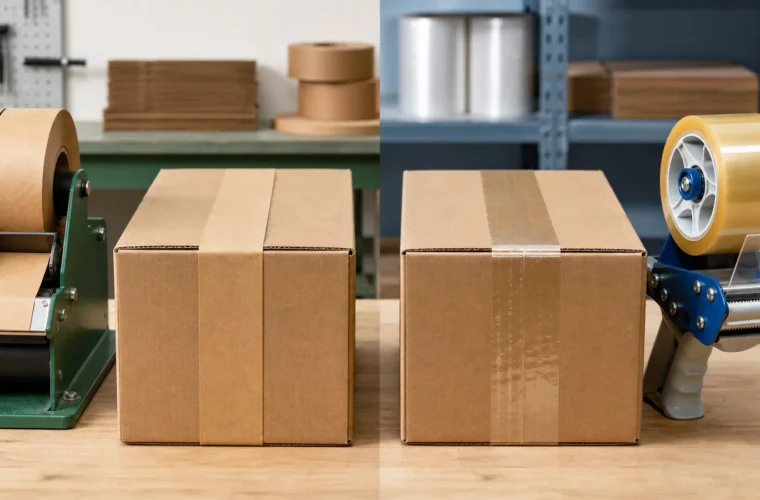
Common Tape Formats Behind the Term
Water-activated paper tape
Water-activated tape has a dry adhesive that is moistened before application. It is commonly used on corrugated boxes and requires a compatible activation method or dispenser. Standard and reinforced paper constructions may be available.
BrandTapeCo’s current product is custom printed kraft paper tape activated with water. It is available in standard or reinforced kraft paper, with 1.89 in (48 mm) and 2.36 in (60 mm) width options. That is one specific type of custom printed carton sealing tape—not the definition of the entire category.
Pressure-sensitive film tape
Pressure-sensitive film tape is tacky on the roll and adheres when pressed onto a surface. Suppliers may offer clear, white, or colored film with custom printing. Film type, thickness, adhesive, unwind, print durability, and carton compatibility remain separate specifications.
Self-adhesive paper tape
Some paper tapes use a pressure-sensitive adhesive rather than a water-activated adhesive. They may have a paper appearance while fitting a different packing workflow. Buyers should not assume that “paper tape” and “gummed tape” mean the same thing.
The guide to choosing custom packaging tape provides a broader decision process for comparing formats around the carton and shipping operation.
Build the Specification From the Carton Outward
Start with the shipment, not the logo.
Record:
- Carton dimensions and construction.
- Packed weight or practical weight range.
- Board surface, including printing or coatings.
- Closure style and required seam coverage.
- Handling route and storage conditions.
- Current packing-station equipment.
- Approximate cartons packed per shift or month.
- Any failure or handling issue the new tape is expected to address.
These inputs help determine which material and application system should be tested. Artwork comes after the functional shortlist because the usable print area depends on the selected tape width and background.
Specify the Roll, Not Just the Artwork
A buyer-ready request should identify the roll construction and dimensions. Use the packaging tape roll specification checklist to record width, length, material, printing, and dispenser requirements.
At minimum, ask the supplier to confirm:
- backing material;
- adhesive/application type;
- reinforcement, if any;
- finished tape width;
- roll length;
- core or equipment compatibility when relevant;
- print-color options;
- artwork format;
- proof and approval process;
- quantity basis for the quote;
- destination and shipping assumptions.
Do not compare two “roll prices” until the roll specifications are normalized. A longer roll, wider tape, different reinforcement, or different printing option can make an apparently simple price comparison misleading.
Prepare Artwork for the Selected Tape
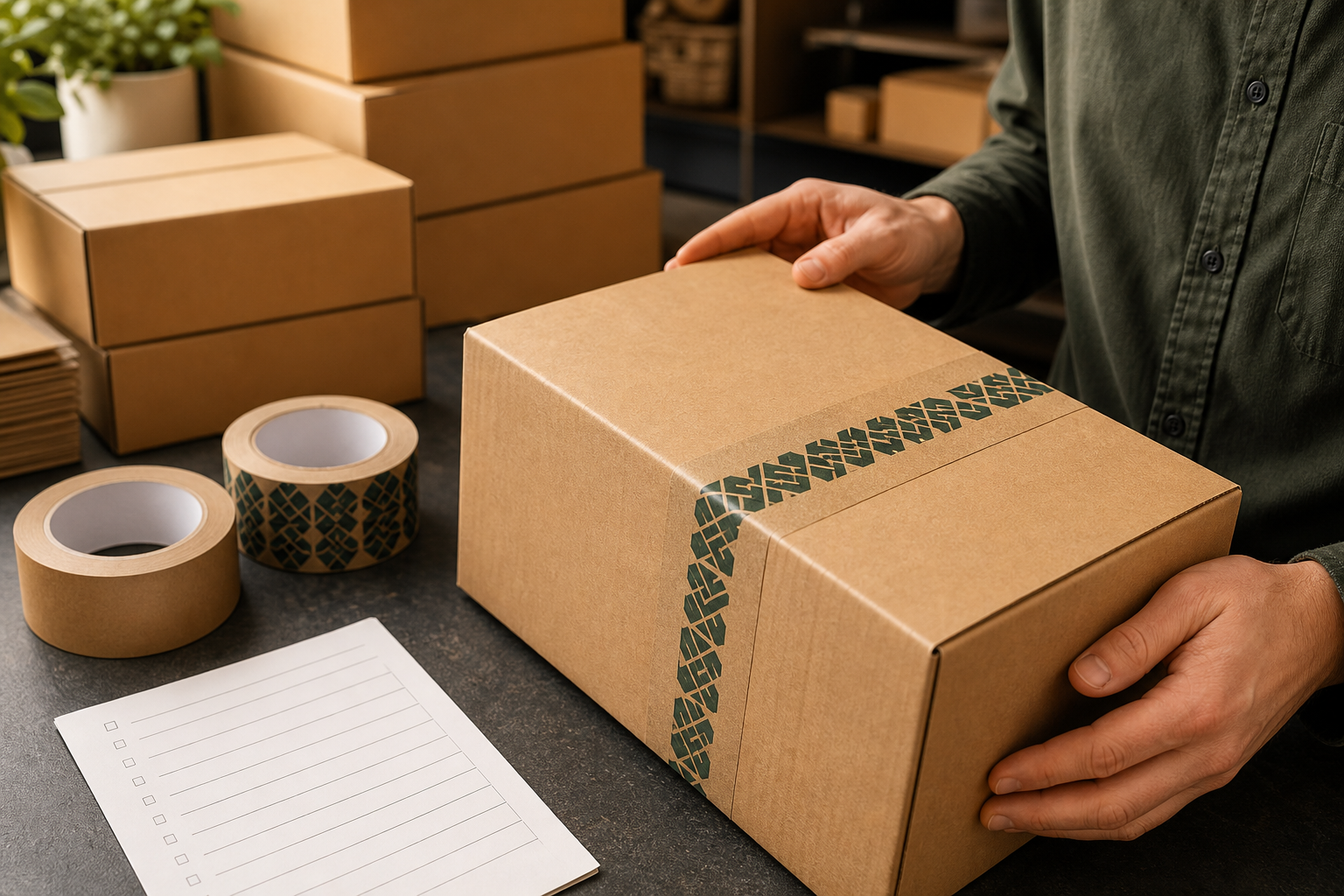
Custom printed box tape is a narrow, repeating print surface. Artwork that works on a website header or full shipping box may not remain readable when reduced to tape width.
Before production, decide:
- whether the design is a single repeated logo or a logo plus text;
- the repeat direction and spacing;
- which colors must be communicated to the supplier;
- how the background material affects contrast;
- whether fine lines or small text need to be simplified;
- who approves the final production proof.
BrandTapeCo currently accepts AI, PDF, SVG, or EPS as preferred production artwork formats and provides a digital proof before production. Its custom printed gummed tape artwork guide covers source files, color communication, repeat patterns, and proof review in more detail.
A Buyer’s RFQ Example
“Custom printed carton sealing tape” is too broad for a comparable quote. A stronger request looks like this:
We are evaluating custom printed tape for corrugated ecommerce cartons. Please review our representative carton range, packed weights, current dispenser, monthly carton volume, destination, and attached artwork. Confirm the proposed material, reinforcement, tape width, roll length, printing option, proof process, and any sample or compatibility testing needed before quotation.
That request does not invent a required construction. It gives the supplier enough context to recommend and confirm one.
For a fuller purchasing handoff, use the custom gummed tape RFQ checklist.
How BrandTapeCo Fits the Category
BrandTapeCo supplies custom kraft paper packing tape with water-activated adhesive for corrugated-box sealing. Current confirmed options include:
- standard or reinforced kraft paper;
- 1.89 in (48 mm) and 2.36 in (60 mm) widths;
- 164 ft (50 m) roll length;
- one-color, two-color, or full-color printing;
- repeated logo patterns;
- digital artwork proof before production;
- small custom orders starting at five rolls.
These details define the BrandTapeCo product. They should not be assumed to apply to every supplier using the broader phrase “custom printed carton sealing tape.”
Frequently Asked Questions
Is carton sealing tape the same as packing tape?
The terms often overlap in ordinary buying language. “Carton sealing tape” emphasizes the task of closing corrugated cartons, while “packing tape” can be used more broadly. Always confirm the construction and application method.
Is custom printed carton sealing tape always plastic?
No. It can refer to printed film tape, water-activated paper tape, or other carton-closing formats. The product name alone does not confirm the backing.
Is custom printed carton sealing tape the same as gummed tape?
Not necessarily. Gummed tape identifies a water-activated adhesive format. Carton sealing tape is the broader functional category.
What information should I send for a quote?
Provide carton details, packed weight, surface condition, tape width, roll requirements, application equipment, printing needs, quantity, artwork, destination, and any testing requirement.
Should I choose the print design before the tape width?
Shortlist the functional tape configuration first. Width and background affect the usable artwork area, repeat, and contrast.
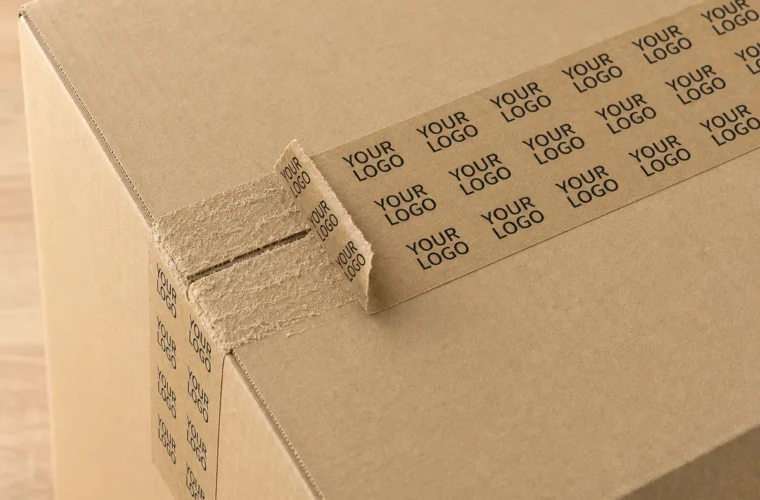
Can printed carton tape show that a box was opened?
Some tape/carton combinations may leave visible surface disturbance after removal. That is evidence to evaluate on the actual carton, not a guarantee against tampering or theft.
Conclusion
Custom printed carton sealing tape is a useful sourcing term, but it is not a complete specification. It tells a supplier that the buyer wants branded tape for closing cartons; it does not settle the material, adhesive, reinforcement, dimensions, equipment, or proof process.
Translate the term into carton, roll, application, artwork, and commercial inputs before comparing quotations. If water-activated kraft paper fits the intended workflow, review BrandTapeCo’s custom printed carton-sealing option and submit the real carton and order requirements for confirmation.
Next step: review custom printed packing tape options for current configurations and order-specific details.