Teams evaluating water activated tape in cold warehouses often ask for a single minimum temperature. Humid facilities raise the opposite question: will moisture in the air or carton change the seal? Neither question can be answered responsibly from room temperature alone.
The practical test has to separate storage, application, and post-application exposure. A roll stored cold, a carton arriving cold, and a sealed box entering a cold room are three different conditions. The same distinction matters for humidity and condensation.
Start by Mapping the Environmental Sequence
Write down what happens to the roll, carton, product, dispenser, and finished package from receipt through shipping.
| Stage | Environment to record | Why it matters |
|---|---|---|
| Tape storage | Temperature and humidity history; unopened or staged | Roll and paper condition before use |
| Empty-carton storage | Board temperature, humidity exposure, dust, coating | Surface receiving the activated adhesive |
| Packing station | Air conditions, dispenser location, water supply, dwell time | Actual activation and application process |
| Product loading | Cold, frozen, wet, or room-temperature contents | Possible condensation and carton distortion |
| Post-seal staging | Time before movement; ambient conditions | Seal development under the real workflow |
| Cold or humid zone | Duration, transitions, handling | Exposure after the carton has been closed |
| Carrier route | Vehicle, dock, handoffs, weather changes | Conditions outside the facility |
A warehouse labeled “cold” may contain a room-temperature receiving dock, a chilled staging lane, and a freezer. “Humid” may mean stable high humidity or repeated transitions that create surface moisture. Test the sequence, not the label.
Separate Cold Storage From Cold Application
These scenarios should not be combined:
- Cold roll, cold carton, cold application: Every part of the process begins in the cold area.
- Conditioned roll, cold carton: Tape and dispenser are kept in a controlled station, but cartons arrive cold.
- Room-temperature application, cold exposure later: The carton is sealed under normal conditions and then moved.
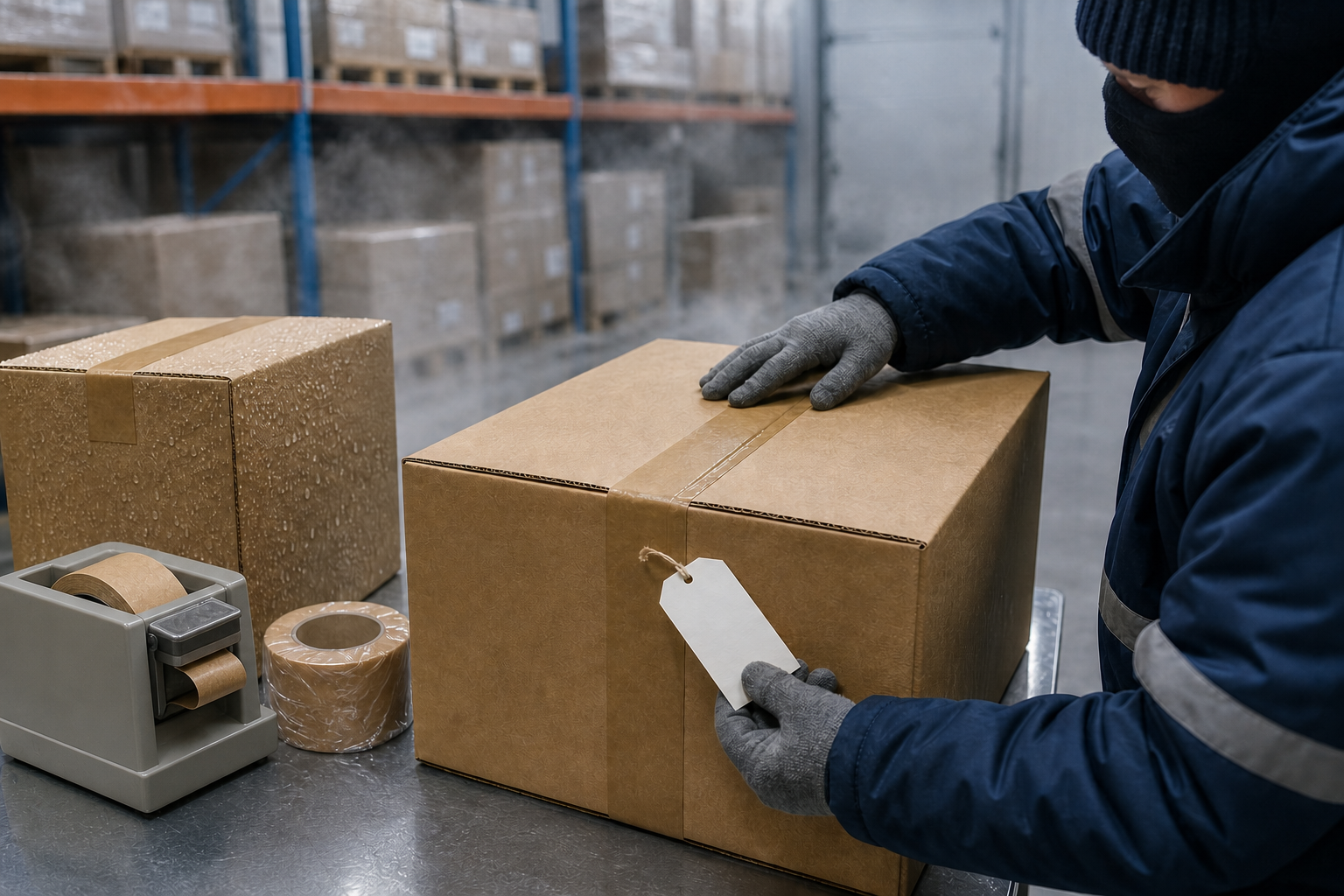
- Cold product in a warmer room: Condensation may develop on the liner or near the seam after loading.
If the operation only tests the third scenario, it has not established that cold application works. If it only tests a freshly sealed dry carton, it has not evaluated condensation during staging.
BrandTapeCo’s current product page advises buyers to confirm carton, dispenser, and testing requirements for demanding storage or shipping environments. It does not publish a universal operating temperature or humidity range. Record that limit as not specified until order-specific information is provided.
Water-Activated Tape Humidity: Inspect the Carton, Not Just the Air
Relative humidity readings provide context, but the tape bonds to the carton surface. Check whether the liner is dry, visibly damp, softened, warped, dusty, coated, or damaged.
Do not assume that adding more water during activation will correct a damp or difficult carton. Wetting the adhesive and exposing the board to uncontrolled moisture are not the same process. The water-activation process checklist helps teams keep dispenser and application variables under control while the environment changes.
Watch for:
- visible condensation on flaps or tape;
- wavy or softened linerboard;
- crushed edges and flap misalignment;
- water marks, surface contamination, or frost;
- cartons taken directly from outdoor or refrigerated storage;
- inconsistent board condition within one pallet.
If a carton is visibly wet or structurally compromised, put it on hold under the site’s packaging procedure rather than treating tape as a repair.
Build a Controlled Cold-and-Humidity Test Matrix
Choose the most common condition and the reasonable demanding case. Do not test every theoretical combination, but do include the variables that actually occur.
| Test variable | Example levels to define from the operation |
|---|---|
| Tape condition | Stored as specified; staged at station; exposed to unusual condition |
| Carton condition | Conditioned; cold and dry; humid-exposed; transition with possible condensation |
| Carton SKU | Main board and a demanding board or printed surface |
| Packed load | Typical load and approved demanding load |
| Application | Intended dispenser, water setting, strip length, pressure, operator |
| Post-seal time | Actual delay before movement or stacking |
| Exposure route | Actual cold room, dock transition, vehicle, or humid zone |
| Inspection points | Immediately after application, after staging, after exposure, after handling |
The values in the right column must come from the facility, supplier guidance, or buyer-approved procedure. Do not invent a temperature threshold because it appears in another tape’s data sheet.
Run the Test Without Losing the Variables
1. Identify every specimen
Assign a carton ID and record tape product or sample, lot if available, carton SKU, board condition, packed weight, operator, dispenser, application time, and environmental sequence.
2. Stabilize the baseline
First run the water-activated tape application test under the facility’s normal approved conditions. If the baseline is inconsistent, an environmental comparison will not explain the problem.
3. Change one environmental scenario at a time
Keep carton, load, strip length, and application method consistent while testing a defined cold or humid condition. Then repeat with the demanding carton if required.
4. Use real transitions
If cartons move from a freezer to a warm dock, or from an air-conditioned room into humid air, reproduce that sequence. A stationary environmental reading does not capture condensation during a transition.
5. Inspect the completed seal and the box
Record objective observations such as:
- full contact versus lifted areas;
- wrinkles, channels, or dry-looking zones;
- tape splitting or damage;
- linerboard tear or delamination during an approved opening check;
- flap movement, seam opening, or carton distortion;
- differences between immediate and later inspections.
Use the corrugated carton tape compatibility test to connect those observations to the actual board rather than attributing every issue to temperature.
Diagnose the Sequence Before Changing the Tape
| Observation | Questions to investigate first |
|---|---|
| Lifting begins at application | Was activation even? Was the carton surface cold, damp, dusty, coated, or warped? |
| Seal looks acceptable, then lifts after transition | Did condensation develop? Did the carton distort? How long elapsed before movement? |
| Only one carton SKU fails | Is its liner, print, coating, recycled content, or seam different? |
| Results vary by station | Are dispenser settings, water condition, strip length, pressure, and maintenance controlled? |
| Tape or roll is visibly distorted | Was stock stored or staged outside supplier guidance? |
| Failure appears after handling | Is the issue environmental, mechanical, or a combined route effect? |
Do not respond to a weak seal by increasing water, choosing reinforced tape, or widening the strip without evidence. Each change can introduce another variable. Re-test one documented change at a time.
Procurement Questions for Demanding Environments
Ask the supplier to respond to the actual process:
- What storage and conditioning guidance applies to this exact tape construction?
- What application environment is supported?
- Does the guidance differ for standard and reinforced paper?
- Which dispenser and activation controls are required?
- What carton information is needed for sample review?
- Does printing change any relevant handling guidance?
- Which performance data or test method supports an environmental claim?
- What should trigger a hold, reconditioning step, or new sample test?
Keep the answer with the approved tape specification. The long-distance shipping carton guide can extend the same record into carrier handoffs and route exposure.
What the Current BrandTapeCo Product Page Confirms
BrandTapeCo offers custom printed water-activated kraft tape in standard and reinforced kraft paper. The current page lists 1.89 in (48 mm) and 2.36 in (60 mm) widths and requires a digital production proof before printing. It does not state a universal cold-service limit, humidity range, conditioning period, or environmental performance guarantee. Confirm those requirements for the proposed order and test the actual cartons.
Frequently Asked Questions
Does water-activated tape work in a cold warehouse?
It may, but the answer depends on the exact tape, roll condition, carton temperature and surface, dispenser, application process, and exposure sequence. Obtain product-specific guidance and test the real workflow.
Can water-activated tape be applied to a cold carton?
Do not assume room-temperature results apply. Test cold-carton application separately from cartons that are sealed warm and moved cold later.
Does humidity make water-activated tape stick better?
No general conclusion should be drawn. Controlled activation is different from uncontrolled humidity or a damp carton. Inspect the board and follow product-specific application guidance.
What if condensation forms after the box is sealed?
Reproduce that transition in the test and inspect both the tape and carton at defined times. Also check whether the carton distorts or softens.
Should tape rolls be kept outside the cold room?
That depends on supplier storage and conditioning guidance plus the packing layout. If rolls are staged in another area, document the transfer time and make sure operators use only approved stock.
Is reinforced water-activated tape automatically better in cold conditions?
Reinforcement addresses tape construction, not every environmental or application problem. It does not correct poor activation, wet board, contamination, or unsuitable storage.
Set the Environmental Approval Boundary
Approve the tested sequence, not the vague label “cold warehouse.” The record should state where the roll was stored, the carton condition at application, the dispenser setup, any temperature or humidity transition, and when the seal was inspected.
Send those conditions with the BrandTapeCo inquiry. An order-specific review can then address the actual carton and route without turning one successful trial into a universal environmental claim.