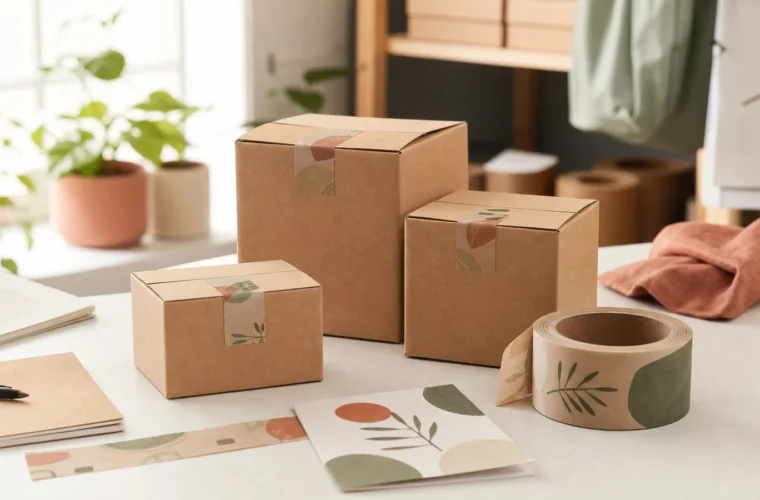

Take three identical corrugated boxes. Seal the first with brown kraft paper tape, the second with clear film tape, and the third with a colored or printed strip.
The products inside have not changed. The carton has not changed. Yet the package communicates something different before anyone opens it.
Choosing color packing tape is not only a visual decision. Brown, clear, and colored tape can use different backings and adhesive systems, interact differently with the carton surface, and create different printing constraints. Start with the closure job, then choose the appearance.
Box One: Brown Tape Blends With the Carton
Brown kraft paper tape works with the natural color of many corrugated boxes. The result can feel restrained because the closure follows the carton rather than sitting on top of it as a transparent or high-contrast strip.
That appearance is useful when a brand wants:
- a paper-forward exterior;
- a neutral background for a dark logo;
- branding that feels integrated with a kraft box;
- a less reflective surface in product photography;
- a visible paper strip without a bright color field.
Brown does not mean invisible. A printed mark can still be prominent, especially in black or another color with sufficient contrast. But the kraft background affects how the ink looks. A color approved on a white monitor may appear different on brown paper.
The printed kraft paper tape design guide explains why artwork should be reviewed on the actual background rather than on a white digital artboard.
What brown tape does not prove
A brown paper appearance should not automatically be called recyclable, biodegradable, plastic-free, or environmentally superior. Those claims depend on the complete tape construction, reinforcement, ink, adhesive, local recycling process, and evidence available from the supplier.
Choose brown kraft tape because its construction and appearance fit the package, not because the color alone suggests an environmental claim.
Box Two: Clear Tape Lets the Carton Show Through
Clear packing tape places the carton color underneath the tape’s appearance. On a plain kraft box, it can make the closure visually quieter from a distance. It can also create reflections, visible edges, or changes in color where the film overlaps.
Clear film tape may make sense when:
- the business wants a low-profile exterior;
- the box is already printed;
- branding is handled through labels or the product package;
- the tape should avoid introducing another color;
- easy visual inspection of the seam is useful.
“Clear” does not mean visually absent. Gloss, wrinkles, trapped dust, overlapping strips, and uneven application may still be noticeable. The result depends on the film, adhesive, carton, lighting, and packer.
If you are considering custom clear packing tape, ask how white areas, transparent areas, and ink colors are produced. A transparent backing behaves differently from white paper in print. Do not assume a logo will look identical across both materials.
Box Three: Color Packing Tape Becomes Part of the Package
Colored tape creates the strongest separation from a plain box. That color may come from the tape backing, printed ink, or both. Buyers should ask which method is being quoted rather than treating every colored strip as the same product.
Color can be useful for two different jobs.
Brand recognition
A distinctive brand color can make a plain carton easier to associate with the sender. It works best when the color reference is documented and the logo remains readable on the chosen background.
Operational identification
Some packing operations use color to distinguish brands, destinations, product groups, or temporary workflows. This can help at the packing bench, but color should not replace barcodes, order records, destination labels, or required handling marks.
If red means “Brand A” at one station and “expedited” at another, the system will create confusion. Publish the meaning and keep it consistent.
The Same Logo on Three Surfaces
The background changes the logo before the artwork itself changes.
| Tape appearance | What happens visually | Artwork question |
|---|---|---|
| Brown kraft paper | The natural paper tone becomes part of the design | Does the logo have enough contrast on brown? |
| Clear film | The carton color shows through transparent areas | Which parts print, and which remain transparent? |
| Solid or heavily printed color | The tape becomes a strong color band | Does the logo remain readable without looking crowded? |
Use a physical-scale mockup for all three. Place the strip over the real carton seam, bend it over an edge, and view it beside the shipping label.
Color references also need to be explicit. “Dark blue,” “kraft brown,” or “close to our website color” can mean different things to different people. The packaging tape color reference guide explains how to document an approval without pretending screens and printed materials are identical.
Appearance Is Not the Material Specification
Brown, clear, and colored are visual descriptions. They do not fully identify a tape.
A buyer still needs to confirm:
- backing material;
- adhesive system;
- reinforcement, if any;
- tape width;
- roll length;
- application method;
- dispenser compatibility;
- printing method and color limits;
- the carton surfaces used in the operation.
For example, brown tape might be water-activated kraft paper or another paper construction. Clear tape is commonly associated with film, but the actual backing and adhesive still need to be stated. Colored tape may be a colored film, colored paper, or a printed surface.
The water-activated tape vs BOPP tape comparison separates material and application differences from appearance.
Which Option Fits Which Packaging Goal?
| Packaging goal | Strong starting point | What to verify |
|---|---|---|
| Quiet exterior on an already branded box | Clear or plain neutral tape | Reflections, seam visibility, material compatibility |
| Integrated look on kraft corrugated | Brown kraft paper tape | Contrast, proof appearance, adhesive application |
| Strong brand band on a plain carton | Colored or custom printed tape | Color reference, print readability, repeat length |
| Multiple brands at one packing station | Clearly differentiated tape designs | Roll identification and written station rules |
| Discreet shipment | Plain, low-contrast closure | Whether the exterior reveals the product category |
| Paper-based visual direction | Kraft paper tape | Construction and any environmental claim evidence |
These are starting points, not automatic specifications. A visually suitable tape can still be wrong for the carton or packing process.
When Plain Tape Is the Better Decision
A custom color is not required simply because a company has brand guidelines.
Plain tape may be more sensible when:
- the logo is still changing;
- the carton already has a strong printed design;
- the business ships only occasional boxes;
- privacy matters more than exterior recognition;
- fulfillment is handled by a partner that will not stock a separate roll;
- the operation has not yet standardized its carton and closure test.
Color earns its place when it performs a clear identification or branding job that the packaging process can support consistently.
A Three-Box Comparison You Can Run Internally
You do not need a formal consumer study to make a better first decision.
Prepare three representative filled cartons with the same label position. Mock up brown, clear, and colored tape at the intended width and strip length. Then photograph each box:
- directly above the seam;
- from carrying distance;
- beside other outgoing parcels;
- under the lighting used at the packing station;
- at a doorstep or receiving counter;
- after the strip has been cut and opened.
Ask the team practical questions:
- Which version keeps the shipping label easiest to scan?
- Which version makes the sender easiest to recognize?
- Which version is appropriate for the product’s privacy level?
- Which artwork survives the normal cut length?
- Which material fits the carton and application method?
The answer may be a different tape for a different shipping program. It may also be plain tape.
Frequently Asked Questions
Is brown packing tape stronger than clear packing tape?
Color does not determine strength. Compare the actual backing, adhesive, reinforcement, dimensions, carton surface, and application method rather than assuming brown or clear is stronger.
Can a logo be printed on clear packing tape?
Some clear tapes can be custom printed, but transparent areas and ink colors behave differently from printing on white or kraft paper. Confirm the supplier’s printing method and review a proof for the intended carton color.
Does brown kraft paper tape blend into a cardboard box?
It can create a more integrated appearance, but kraft shades vary between tape and corrugated board. Expect a visible strip rather than a guaranteed color match.
Can color packing tape be used for warehouse coding?
Yes, color can support a documented identification system. It should not replace order records, destination labels, barcodes, or legally required handling information.
Is kraft paper tape recyclable?
Do not decide from appearance alone. Recyclability depends on the tape construction, reinforcement, ink, adhesive, and the rules and equipment of the receiving recycling system.
Let the Box Choose the Background
Brown, clear, and color packing tape create different first impressions, but appearance should come after the carton and closure requirements. Compare materials on the real box, reserve space for the shipping label, and review the design at normal cut length.
If a printed kraft paper construction fits the intended look and packing process, explore BrandTapeCo’s custom printed kraft paper tape and evaluate the artwork on your regular corrugated cartons.