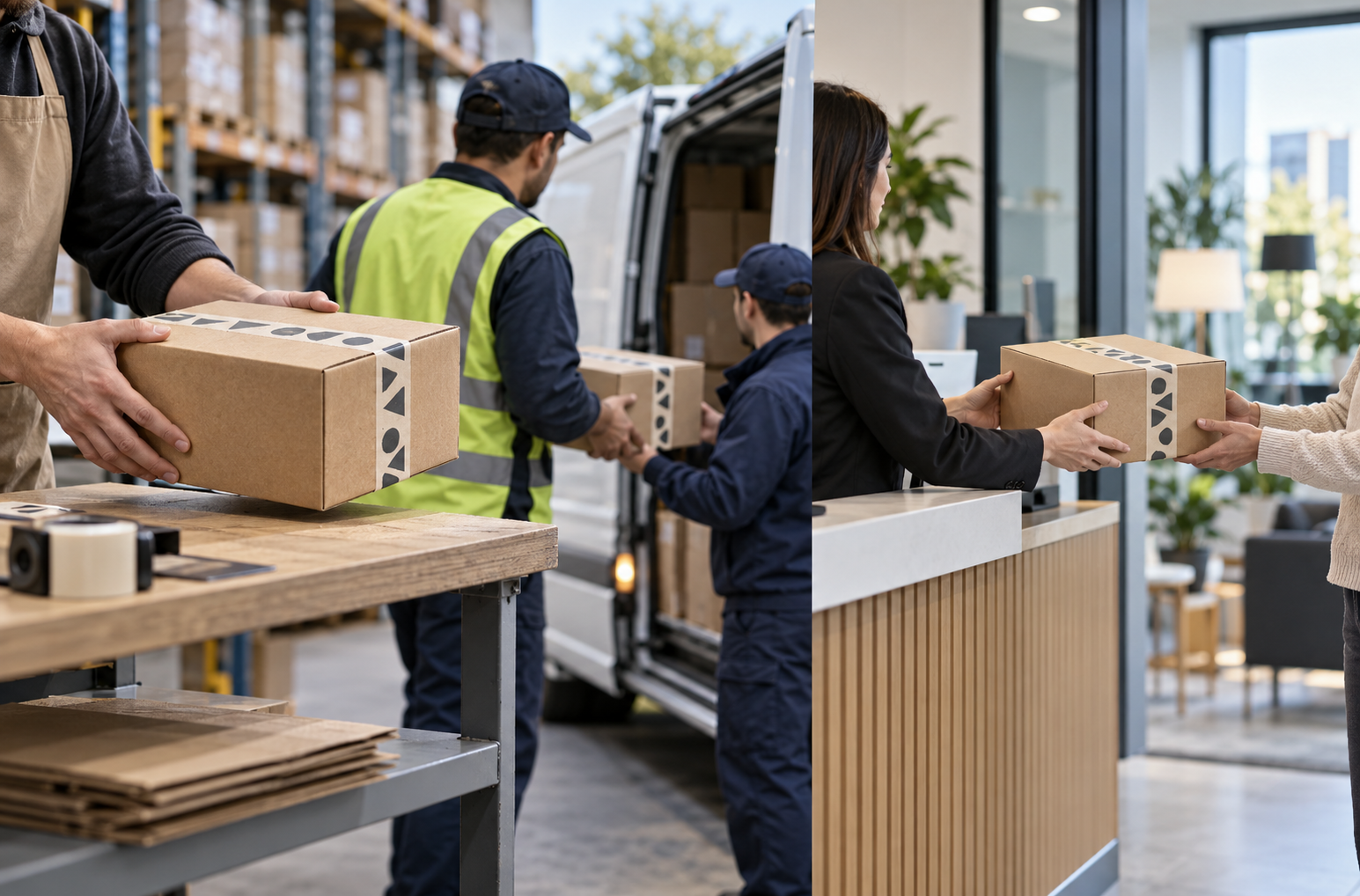
The customer is not the first person to see a branded shipping box. They may not even be the fifth.
Between the packing bench and the final recipient, a parcel can pass through a fulfillment team, carrier pickup, sorting facilities, delivery staff, a reception desk, or a shared parcel room. Branded shipping tape appears at every one of those handoffs.
That does not turn each shipment into guaranteed advertising. It does mean the outside of the box has more than one audience, and the design should account for them.
The Packer Sees It First
At the packing station, branded tape is a working material before it is a marketing element.
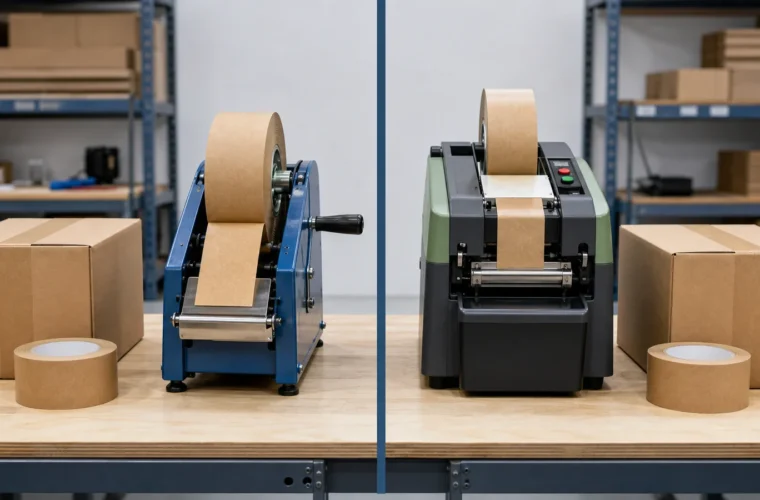
The packer needs to identify the correct roll, load it into the intended dispenser, position the print correctly, and close the carton without covering the label area. If two brands share one station, a clear visual difference between rolls may also help reduce mix-ups.
Artwork that looks polished in a PDF can still create problems on the bench:
- the repeat may be too long for smaller boxes;
- the mark may face the wrong direction after application;
- a long message may be cut in half;
- the shipping label may cover the only complete logo;
- similar roll designs may be difficult to distinguish quickly.
The first test should therefore be operational: can a normal packer use the tape correctly without stopping to interpret it?
The Warehouse Sees a Box in a System
A warehouse worker usually does not study the branding. The carton is one unit in a larger flow.
They may look for a destination, order reference, carrier label, handling instruction, or sign that a package belongs to the wrong outbound group. The tape can provide recognition, but it should not imitate carrier labels or compete with scannable information.
This is especially relevant for brands shipping wholesale orders to stores. A branded box may arrive at a retailer’s receiving area rather than a customer’s home. The wholesale retailer order guide explains how to keep branding separate from routing and receiving information.
For warehouse use, visual hierarchy matters:
- carrier and destination information must remain readable;
- required handling marks need their own space;
- the tape should close the seam cleanly;
- the brand should remain recognizable without dominating the logistics information.
The Carrier Sees a Shipping Surface
Pickup and delivery staff handle the box as freight, not as a brand presentation.
They need a package that is closed, label-ready, and easy to move through the network. A logo does not change the carrier’s handling standards, and printed tape should never be presented as protection against rough handling, loss, or theft.
The useful contribution is simpler: the box can be visually identifiable without adding another sticker or printed carton SKU.
If the tape contains a message, keep it short. “Thank you” or a concise brand line can survive an imperfect cut. A paragraph, multiple social handles, or detailed opening instructions usually will not.
The custom tape content guide covers the information hierarchy in more detail.
A Receptionist or Mailroom May See It Before the Recipient
Many B2B and workplace deliveries stop at a front desk, loading dock, security station, or central mailroom. The person who ordered the product may receive the carton hours later.
Here, a visible sender name can be useful. It can help staff recognize the package and route it internally. But more branding is not automatically better.
Consider what the outside of the package reveals:
- Does the brand name describe a sensitive product category?
- Is the order intended as a gift or surprise?
- Could a highly recognizable package attract unwanted attention?
- Does the recipient expect discreet shipping?
If privacy matters, plain tape or a restrained exterior can be the more customer-aware choice. Branding can move to the inside of the box.
The Neighbor and the Doorstep Are Unplanned Audiences
A home delivery may be visible to neighbors, building staff, visitors, or anyone passing a shared parcel area.
This exposure is difficult to measure and should not be described as free advertising. The brand does not know who noticed the package, how long it was visible, or whether the impression was positive.
Still, the doorstep is a useful design test. Photograph the proposed box from several feet away. Ask:
- Can the sender be recognized without reading small text?
- Does the tape look intentional from a normal viewing distance?
- Is the exterior too revealing for the product category?
- Does the shipping label obscure most of the print?
The goal is not maximum visibility. It is appropriate visibility.
The Customer Sees the Complete Arrival
The recipient finally sees the carton in context: its condition, label, tape, opening method, and interior presentation.
Branded packing tape can make a plain box easier to associate with the sender. It can also connect the exterior package to the brand used inside. It cannot prove that the customer will reorder, post an unboxing video, or value the product more.
Those limits matter. The branded packing tape and unboxing guide focuses specifically on what tape can and cannot change during opening.
One Box, Several Audiences
| Audience | What they need from the package | Design implication |
|---|---|---|
| Packer | Correct material and repeatable application | Make rolls easy to identify and the print easy to orient |
| Warehouse | Clear routing and scanning | Keep tape away from barcodes and operational labels |
| Carrier | A secure, manageable shipping unit | Do not use branding as a substitute for suitable closure |
| Reception or mailroom | Sender recognition and internal routing | Keep the company name legible if B2B delivery is common |
| Doorstep or parcel room | Appropriate exterior visibility | Consider privacy and unwanted attention |
| Recipient | A recognizable, intact arrival | Use a clear mark and a deliberate opening path |
| Returns team | Evidence of the original and replacement workflow | Document how returned cartons should be resealed |
Does Branded Shipping Tape Create Advertising Value?
It creates a visible brand surface. That is not the same as measurable advertising performance.
To claim advertising value, a company would need evidence connecting package exposure to awareness, visits, inquiries, or sales. Most businesses do not have that attribution. It is more accurate to evaluate branded tape as:
- a repeated identifier on plain cartons;
- a way to keep exterior presentation consistent;
- a possible aid to sender recognition;
- a combined closure and brand element;
- an operational material that must still perform its main job.
This framing is less dramatic, but more useful for a buyer deciding whether the added printing is worth managing.
When Branded Tape Is a Good Fit
Branded shipping tape is easier to justify when:
- the business regularly ships corrugated cartons;
- one design can work across several box sizes;
- the company controls the packing instructions;
- the artwork is stable;
- recipient recognition is useful;
- privacy is not a major concern;
- the shipping label and tape can occupy separate areas.
Plain tape may be the better choice when order volume is irregular, fulfillment is outside the company’s control, the exterior should remain discreet, or the carton already carries a strong printed design.
For Shopify merchants building the entire packing system, the Shopify branded packaging checklist helps assign separate jobs to the box, tape, label, tissue, sticker, and insert.
A Box-Level Review Before Printing
Do not approve branded tape only from the full artwork board. Place a physical-scale paper mockup on the smallest and largest regular cartons.
Review it as each audience would:
- load and apply it like a packer;
- check label clearance like a warehouse operator;
- view it quickly from carrying distance;
- photograph it at a reception desk or doorstep;
- open it as the recipient would;
- decide whether the exterior reveals too much.
This simple sequence often finds problems that a flat digital proof cannot show.
Frequently Asked Questions
Is branded shipping tape the same as custom packing tape?
The terms often overlap. Branded shipping tape usually refers to tape printed with a company name, logo, or brand element for shipping cartons. Custom packing tape can also include operational or handling messages.
Does branded tape count as advertising?
It creates brand visibility on a shipment, but that alone does not prove advertising reach or sales impact. Treat it as a visible packaging element unless you have data connecting exposure to a measurable outcome.
Should a logo appear on every cut strip?
Ideally, a normal strip should contain at least one readable brand mark. Test the repeat against the actual cut lengths used on your smallest and largest regular boxes.
Can printed tape interfere with shipping labels?
Yes. A tape path can cross a label or make the exterior visually crowded. Reserve a clear label area and test the completed carton before approving the layout.
When should a business use plain shipping tape?
Plain tape is often better when privacy matters, the artwork is changing, the business does not control fulfillment, or the shipping box already provides enough exterior branding.
Design for the Handoffs
The most useful branded shipping tape is not designed only for the final photograph. It works for the packer, stays out of the carrier label’s way, remains appropriate in public, and gives the recipient a clear, intentional seal.
If printed paper tape fits those handoffs, review BrandTapeCo’s custom printed self-adhesive kraft tape and evaluate the artwork on the cartons your business actually ships.