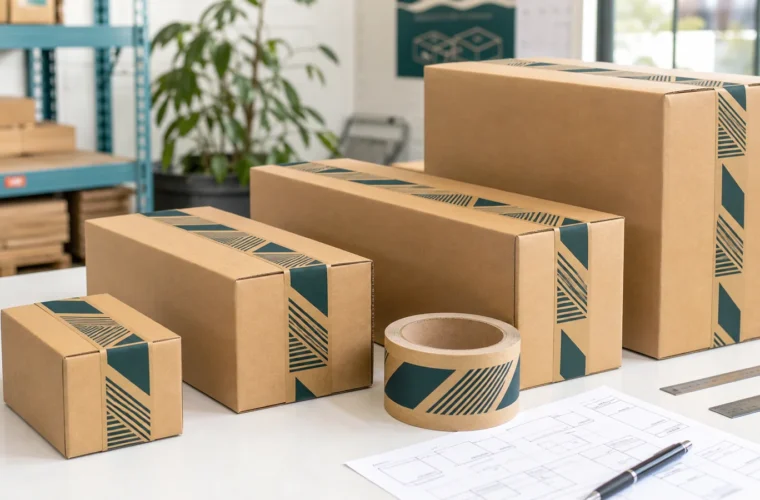
The number of custom tape rolls a business needs cannot be calculated from monthly orders alone. Two stores may each ship 1,000 boxes, but one uses a single short center-seam strip while the other uses larger cartons, longer strips, or more than one closure strip.
The reliable method is to measure tape used per representative box, weight that measurement by the carton mix, and then add a buyer-selected allowance for setup, testing, damaged cartons, and normal process variation.
This calculator uses BrandTapeCo’s current 164 ft (50 m) roll length as an example. The same method works for other roll lengths when the actual supplier specification is substituted.
The Core Calculation
Use one unit throughout the calculation.
For inches:
Roll length in inches = roll length in feet × 12

Theoretical boxes per roll = roll length in inches ÷ measured inches of tape per box

Base rolls required = monthly boxes ÷ theoretical boxes per roll

Planned rolls required = base rolls required × (1 + buyer-selected allowance)
A 164 ft roll contains 1,968 inches of tape. That is a length conversion, not a promise about box coverage.
Always round the final roll count up to a whole roll. For ordering, also account for the supplier’s current minimum quantity and the time needed for proof, production, delivery, and internal approval. Do not invent those timing inputs; confirm them for the order.
Step 1: Measure Tape Use on the Actual Box
The best input is not the box dimension printed in a catalog. It is the length the operator actually dispenses for the approved closure.
Pack a representative carton and record:
- carton SKU or size;
- closure pattern;
- number of strips;
- length of each strip;
- total tape per completed box;
- dispenser setting, if applicable;
- whether the box was underfilled, correctly filled, or overfilled;
- any rework or discarded strip.
Measure several normal applications rather than one perfect sample. If operators use inconsistent lengths, solve the process issue before using the average as a purchasing assumption.
Step 2: Calculate Boxes per Roll
Suppose a representative box uses one measured 24-inch strip.
1,968 inches per roll ÷ 24 inches per box = 82 theoretical boxes per roll
That result assumes every inch of the roll becomes an accepted closure. Real operations may use tape for setup, testing, rework, damaged cartons, operator variation, or partial rolls held at packing stations.
Theoretical boxes per roll should therefore be treated as a planning baseline, not as a guaranteed yield.
Step 3: Account for a Mixed Carton Range
Do not average the length of several boxes unless their shipping volumes are also included.
Use a weighted calculation:
| Carton | Monthly boxes | Measured tape per box | Monthly tape use |
|---|---|---|---|
| Small | 600 | 18 in | 10,800 in |
| Medium | 300 | 26 in | 7,800 in |
| Large | 100 | 38 in | 3,800 in |
| Total | 1,000 | — | 22,400 in |
Then calculate:
22,400 monthly inches ÷ 1,968 inches per roll = 11.38 base rolls
Round up only after applying the business’s documented allowance and inventory policy. The numbers above are illustrative assumptions, not BrandTapeCo performance data.
For a carton range with different board surfaces, widths, or material requirements, use the mixed carton size planning guide before assuming one tape configuration fits every SKU.
Step 4: Choose an Allowance You Can Explain
There is no universal waste percentage. A new manual process, a controlled automated station, and a seasonal fulfillment operation will not have the same variation.
Build the allowance from observed causes:
- initial dispenser setup;
- operator training;
- artwork or application samples;
- rejected or misapplied strips;
- cartons reopened for order corrections;
- damaged cartons;
- partial rolls distributed across stations;
- expected volume change before the next reorder.
If the business has no history, run a limited packing test and record actual use. Keep the assumption visible in the purchasing worksheet so the next order can replace it with real data.
Custom Tape Roll Planning Worksheet
| Input | Your value | Source |
|---|---|---|
| Roll length | ___ ft or m | Confirmed supplier specification |
| Tape length per small box | ___ | Measured packing test |
| Tape length per medium box | ___ | Measured packing test |
| Tape length per large box | ___ | Measured packing test |
| Monthly units by carton | ___ | Order/fulfillment forecast |
| Process allowance | ___% | Observed loss or documented planning assumption |
| Safety stock | ___ rolls | Buyer inventory policy |
| Open rolls at stations | ___ rolls | Packing-station count |
| Reorder trigger | ___ rolls | Usage rate plus confirmed replenishment timing |
Keep the worksheet tied to a specific period. A forecast for peak season should not silently replace a normal-month assumption.
A More Complete Roll Formula
For each carton SKU:
Monthly tape use for SKU = monthly boxes × measured tape per box
Across all SKUs:
Total monthly tape use = sum of monthly tape use for all SKUs

Base rolls = total monthly tape use ÷ confirmed roll length

Operational rolls = base rolls × (1 + allowance)

Order-planning quantity = operational rolls + desired safety stock + station stock − usable inventory on hand
Round upward where required. Then compare the result with the confirmed ordering terms rather than changing the calculation to force a preferred quantity.
Do Not Mix Width and Length
Tape width and roll length answer different questions.
- Width affects seam coverage, artwork space, dispenser compatibility, and the carton configuration being evaluated.
- Roll length affects how much linear tape is available.
A 2.36 in (60 mm) tape is wider than a 1.89 in (48 mm) tape, but width alone does not tell you how many boxes a roll can close. The number of boxes is driven by linear length used per closure.
BrandTapeCo currently lists 1.89 in (48 mm) and 2.36 in (60 mm) widths, each with a 164 ft (50 m) roll length. Select width from the carton and process requirement, then calculate roll quantity using actual strip length.
The packaging tape roll specification checklist helps keep those fields separate.
Convert Monthly Use Into a Reorder Trigger
An order estimate answers “how much will we use?” A reorder trigger answers “when should purchasing act?”
Track accepted boxes per roll for several periods. Then record:
- average weekly roll use;
- peak weekly use;
- current usable inventory;
- rolls already opened at stations;
- approved artwork version;
- confirmed supplier and delivery timing for the specific reorder;
- internal time required for review and approval.
The custom tape reorder planning guide provides a fuller framework for recurring packaging use.
What Changes the Quote Besides Roll Count?
Quantity is only one commercial input. A supplier may also need:
- standard or reinforced material;
- tape width and roll length;
- one-color, two-color, or full-color printing;
- artwork and repeat requirements;
- destination;
- sample or test needs;
- order schedule or recurring-supply context.
Use the custom tape quote factors guide to prepare a comparable request.
BrandTapeCo Roll Facts for the Calculator
BrandTapeCo’s current custom kraft paper packing tape is listed with:
- 164 ft (50 m) roll length;
- 1.89 in (48 mm) and 2.36 in (60 mm) widths;
- standard or reinforced kraft paper;
- one-color, two-color, or full-color printing;
- a minimum small order of five rolls.
Use those figures only for the current BrandTapeCo configuration. Confirm the selected option and order details before purchasing.
Frequently Asked Questions
How many boxes can one 164-foot roll seal?
Divide 1,968 inches by the measured total tape used per box, then account for operational allowance. Without the strip length and closure pattern, there is no responsible fixed answer.
Should I use the box length as tape length?
Not automatically. Measure the approved applied strip, including any extension beyond the seam and every strip used in the closure pattern.
How do I calculate tape for several box sizes?
Multiply the measured tape per box by the monthly volume for each carton SKU, add the results, and divide by the confirmed roll length.
What allowance should I add?
Use an allowance supported by observed setup, training, rework, damage, and station inventory. There is no universal percentage for every operation.
Do custom printed tape rolls have the same length as plain tape?
Do not assume so. Use the finished roll length in the supplier’s confirmed specification. BrandTapeCo’s current custom product lists 164 ft (50 m).
Should I order exactly one month of tape?
Not necessarily. Consider usable stock, station inventory, volume variability, order terms, and confirmed replenishment timing. Keep safety stock as a separate, visible policy input.
Conclusion
Estimate custom tape rolls from measured tape use, not from order count alone. Weight the calculation by carton mix, document the process allowance, separate operating inventory from safety stock, and update the model with actual consumption after each order cycle.
When the estimate is ready, compare it with BrandTapeCo’s custom printed kraft tape configuration and submit the carton, artwork, width, material, quantity, and destination for an order-specific review.