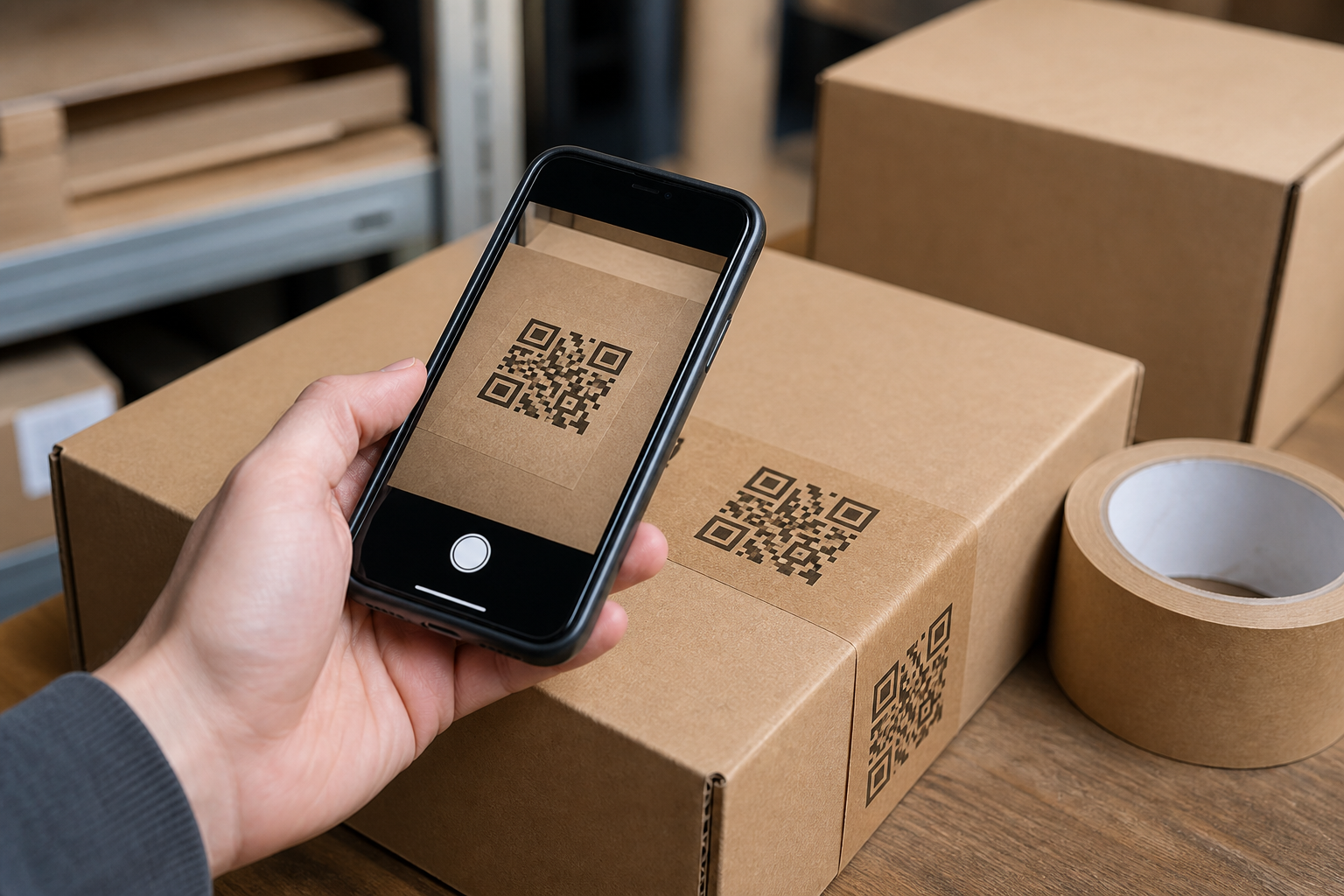
A QR code on custom packaging tape can connect a physical shipment to instructions, product registration, reorder information, or a campaign page. It can also become a small, distorted square that nobody can scan once the tape bends over a box edge.
The decision is not simply whether the artwork file scans on a monitor. The printed code has to survive the tape’s repeat pattern, the available width, the kraft background, the application process, and the way a customer holds the finished carton. That makes a physical carton test the deciding step.
When a QR Code on Custom Packaging Tape Is Worth Testing
Start with the customer action. A code earns space when it gives the recipient a clear reason to use it and sends them somewhere stable.
| Intended action | Sensible destination | Main question before printing |
|---|---|---|
| Product setup | Mobile-friendly setup page | Will the page remain valid for the life of the tape inventory? |
| Care or disposal guidance | Maintained instructions page | Is the information specific and supportable? |
| Reordering | Short product or account path | Can the user still find the destination without scanning? |
| Campaign participation | Controlled campaign landing page | Will tape remain after the campaign ends? |
| Feedback | Short survey or support page | Is the action useful enough to justify artwork space? |
A QR code is a weak choice when the destination changes frequently, the team cannot maintain redirects, or the code pushes the logo and other essential information below a readable size. A short printed domain may be more durable for evergreen tape.
Why a Code That Works on Screen Can Fail on Tape
QR codes are made from a grid of small square modules. DENSO WAVE, the company behind the QR Code, explains that the symbol needs a clear “quiet zone” around it and that larger modules are generally easier to read. Its troubleshooting guidance also warns that distorted modules, insufficient clear space, and overlapping graphics can prevent reliable reading (QR Code area guidance, reading problems).
Packaging tape adds several real-world complications:
- Limited width: The symbol, its clear margin, and any surrounding artwork must fit inside a narrow band.
- Repeated artwork: A code may be cut at an arbitrary point when a strip is dispensed.
- Corners and seams: A complete repeat can land partly on a fold, flap gap, label, or damaged panel.
- Material color: Natural kraft changes the background behind light areas of the code.
- Print production: Fine modules must remain distinct after the supplier’s print process is applied to the tape.
- Application: Wrinkles, skew, excess moisture, rubbed print, or torn fibers can change the finished symbol.
- Use conditions: Lighting, camera quality, viewing angle, and distance vary by recipient.
Error correction does not make placement or print quality irrelevant. Treat it as part of the code specification, not permission to crop, stretch, decorate, or damage the symbol.
Keep the Encoded Destination Short and Controlled
A long destination can produce a denser code. Instead of printing a long URL with campaign parameters, use a short domain or controlled redirect owned by the business. The redirect can point to the current destination while the printed code remains unchanged.
Before artwork approval, assign an owner for:
- the short URL or redirect;
- the landing page;
- mobile testing;
- privacy and analytics review;
- the fallback plan if the destination changes.
Do not encode a link owned by an employee, temporary agency account, or unmaintained third-party generator. The tape may remain in storage and circulation much longer than a digital campaign asset.
Design the QR Code as a Complete Repeat Unit
The code needs a repeat position that can appear whole on a usable carton panel. Work from the supplier’s repeat layout rather than placing a square into a generic tape mockup.
Ask these questions during the repeating logo pattern review:
- How far apart are complete codes in the repeat?
- Can a normal strip length include at least one complete code?
- Where can operators place that complete code on a flat panel?
- Does the cut point regularly split the code?
- Can the code and logo remain visually separate?
- Is the required clear area free of borders, type, texture, and other marks?
Avoid placing the QR code directly over the center seam if the flap gap or tape contour can distort it. The tape can still close the seam while a complete code repeat continues onto a flat top or side panel, but that placement has to be tested with actual strip lengths and cartons.
Build a Physical Scannability Test
The proof is necessary, but it is not the final test. BrandTapeCo’s current product page states that an on-screen preview is a visual reference and that a digital production proof must be approved before printing. A printed sample on the real package adds the application evidence the screen cannot provide.
1. Define the test matrix
Use representative combinations rather than one perfect sample.
| Variable | Include in the test |
|---|---|
| Cartons | Main box sizes, board colors, printed or coated surfaces |
| Placement | Flat top, flat side, near an edge, and the intended production position |
| Application | More than one trained operator or station when relevant |
| Devices | Several current phones used by the target audience |
| Lighting | Normal receiving area, office light, and lower-light conditions likely in use |
| Package condition | Freshly packed plus representative handling, scuffing, or light creasing |
| Distance and angle | Comfortable customer use, not only a carefully aligned close-up |
2. Record results by specimen
Do not write “QR works” after a single successful scan. Give each carton a specimen ID and record carton SKU, tape version, placement, device, lighting, scan result, redirect result, and any visible defect.
3. Test the entire journey
A successful camera read is only the first checkpoint. Confirm that:
- the code opens the correct destination;
- the page loads on a phone;
- the page explains what the customer should do;
- the destination uses an expected domain;
- redirects and analytics do not create a warning or broken path;
- a human-readable fallback remains available.
4. Define pass criteria before the test
The buyer should decide what combinations must work before seeing results. Otherwise, a convenient sample can be used to excuse failures on common boxes or devices. If the code is optional, a different criterion may be acceptable than for required setup or safety information. Required information should not depend solely on a QR code.
What to Review on the Production Proof
Use the custom tape proof approval checklist and add QR-specific checks:
- destination and redirect tested;
- code file is not stretched or compressed;
- clear zone remains intact;
- code size is stated on the repeat layout;
- code does not collide with the logo or cut boundary;
- background and print colors provide strong separation;
- repeat spacing provides a realistic complete-code opportunity;
- proof version matches the approved landing-page owner and campaign record.
Natural kraft is not the same as a white screen background. Review contrast using the proposed material and print specification. The logo readability on kraft tape guide applies the same practical principle: judge the mark against the actual paper appearance, not an isolated digital file.
When to Leave the QR Code Off
Skip the code when any of these conditions remain unresolved:
- the supplier cannot support the required printed detail at the proposed size;
- the tape width leaves no workable clear area;
- operators cannot reliably place one complete code on a flat surface;
- the destination will expire before the rolls are used;
- there is no page or redirect owner;
- the information must remain available without a phone or internet connection;
- physical samples do not meet the buyer’s scan criteria.
Custom tape can still carry a logo, short domain, or brief message. The custom printed gummed tape artwork guide covers those broader choices without making the code the center of the design.
What BrandTapeCo Can Confirm Before You Order
BrandTapeCo currently offers custom printed kraft paper tape in standard or reinforced kraft paper, with one-color, two-color, or full-color printing and a digital production proof before printing. The page does not publish a guaranteed minimum QR-code size or universal scannability result. Submit the proposed code and destination with the artwork, then evaluate an order-specific proof and physical sample before relying on it.
Frequently Asked Questions
Can a QR code be printed on kraft packing tape?
It may be possible, but suitability depends on the code size, tape width, material appearance, print process, repeat, and placement. Ask the supplier to review the exact artwork and test a printed sample.
How small can a QR code be on packaging tape?
There is no universal tape-specific answer. Module size, encoded data, printer capability, scanner, clear space, material, and finished placement all matter. Use supplier guidance and a physical test instead of copying a generic minimum.
Should the QR code replace a printed website URL?
Usually not. A short domain gives recipients a fallback when the code is damaged, split by a cut, or difficult to scan.
Can a QR code cross the carton seam?
That placement adds risk because the flap gap, contour, and opening damage can distort the symbol. Test a complete code on a flatter area whenever possible.
Should each tape repeat contain the same QR code?
For one controlled destination, repeating the same code is simpler to manage. Confirm that the repeat and normal strip length provide at least one complete, usable symbol.
Do I need to test both the proof and the printed tape?
Yes. The proof checks layout and content; the printed-carton test checks real size, contrast, cutting, application, surface shape, devices, and the landing-page journey.
Decide From the Printed-Carton Test
A QR code earns its place only after a complete printed repeat scans on the cartons, devices, lighting, and placement conditions customers will encounter. The landing page also needs an owner, a stable redirect, and a readable fallback.
If those checks pass, send BrandTapeCo the code, destination, placement plan, and proof requirements with the artwork. If they do not, a short domain and a clearer logo will usually serve the package better.
Next step: review custom printed packing tape options for current configurations and order-specific details.