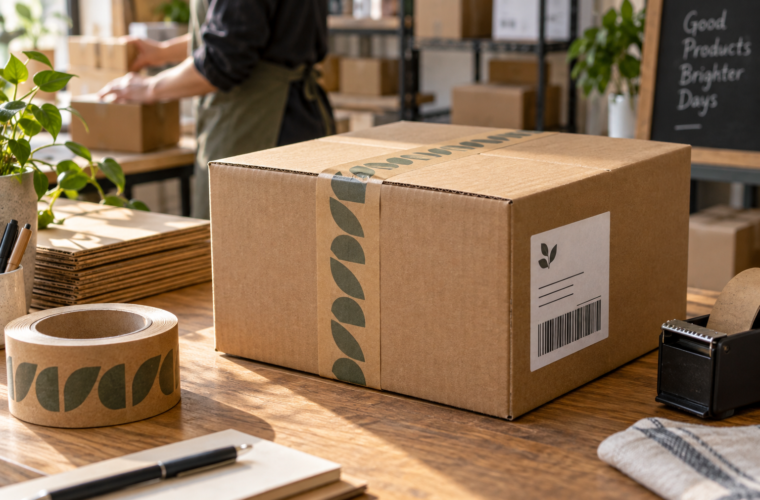
Custom tape for a small business can turn a required box-closing step into a repeated brand element. That does not make it the right first packaging purchase for every operation.
If the shipping process is unstable, the artwork changes constantly, or the business does not control fulfillment, plain tape may be the more responsible choice. A sticker, stamp, stock tape, or later rollout can preserve flexibility while the packaging system matures.
The purpose of this guide is not to argue against custom tape. It is to answer a narrower buying question: when is custom tape worth testing for a small business, and when is it more likely to create leftover inventory, operational friction, or branding that adds little value?
A Quick Custom-Tape Fit Test for a Small Business
Custom tape for a small business is more likely to be worth evaluating when the operation can answer “yes” to most of these questions:
- Do we regularly ship corrugated boxes?
- Do we control the packing station or fulfillment instructions?
- Is the brand artwork approved and likely to remain stable?
- Can one tape design work across the intended carton range?
- Do we know the material, width, dispenser, and application process to test?
- Can we estimate roll use from actual shipments?
- Is visible exterior branding important to the customer experience or brand system?
If several answers are “no,” solve those gaps before treating custom tape as the next packaging investment.
Case 1: You Do Not Control the Fulfillment Process
Print-on-demand providers, marketplaces, dropshippers, and third-party fulfillment partners may control which boxes, tape, labels, and packing stations are used.
Buying custom tape before the operator agrees to receive, store, load, apply, and reorder it can leave the rolls unused. The fulfillment partner may also require a specific tape format or equipment that does not match the proposed product.
Before ordering, confirm:
- whether customer-supplied packaging materials are allowed;
- which carton sizes and surfaces are used;
- who owns the tape inventory;
- which dispenser or activation method is available;
- whether the operator will follow a documented application standard;
- how partial rolls and reorders are tracked;
- what fees or handling rules apply.
If those answers are unavailable, use the provider’s standard closure and focus branding on surfaces you control, such as inserts, product packaging, or post-purchase communication.
Case 2: Your Artwork or Brand Name Is Still Changing
Custom printed tape creates physical inventory tied to one artwork version. A logo refresh, URL change, legal-name update, seasonal slogan, or packaging redesign can make unused rolls obsolete.
Plain tape is often better during a rebrand or early identity test. A small sticker, stamp, or unprinted closure allows the business to change its message without discarding a larger custom run.
Custom tape becomes easier to justify when:
- the logo file is approved;
- the brand colorway for kraft or white backgrounds is documented;
- the website URL is stable;
- the design works as a short repeat;
- the same artwork can serve more than one carton SKU;
- an owner is assigned to approve the proof.
For early-stage brands, the sample-to-bulk order workflow helps separate an artwork experiment from a production-ready specification.
Case 3: You Rarely Ship Corrugated Boxes
Custom packing tape is most visible and functionally relevant when it closes shipping cartons. A business that mainly uses poly mailers, padded mailers, local pickup bags, pallets, or supplier-direct shipping may not use enough carton tape to make it an effective branding surface.
Do not force the product into an unsuitable packaging system. Start by counting actual shipments by format:
| Shipping format | Monthly shipments | Does carton-sealing tape have a job? |
|---|---|---|
| Corrugated box | ___ | Usually yes; confirm closure specification |
| Poly mailer | ___ | Usually no carton seam to close |
| Padded mailer | ___ | Usually no separate carton tape required |
| Local pickup bag | ___ | Branding may belong on the bag, label, or receipt |
| Third-party shipped | ___ | Depends on fulfillment control |
If only a small share uses boxes, calculate the expected roll consumption and likelihood of artwork changes before ordering.
Case 4: Your Packing Process Is Not Stable Yet
Custom print does not fix a weak closure process.
If operators use inconsistent strip lengths, cartons are frequently overfilled, tape lifts from dusty surfaces, or the dispenser is not maintained, adding a logo may make the problem more visible without solving it.
Stabilize:
- carton selection;
- packed weight and fill level;
- closure pattern;
- tape material and width;
- dispenser setup;
- operator method;
- application test;
- issue recording.
Then add print to the configuration that passes the functional review.
The guide to choosing custom packaging tape begins with the carton and workflow, while BrandTapeCo’s ecommerce packaging guidance helps small brands build a repeatable bench process.
Case 5: The Branding Benefit Is Too Small for the Inventory Commitment
Custom tape is visible on the outer carton, but that surface may not matter equally to every business.
Plain tape may be enough when:
- shipments are business-to-business and immediately unpacked in a receiving area;
- an outer carton is removed before the product reaches the customer;
- the shipping box is already fully printed;
- a carrier pouch, overwrap, or label would cover most of the tape;
- the brand experience is intentionally concentrated inside the package;
- the tape design would repeat information already dominant on the carton.
The question is not whether branded tape looks better in isolation. It is whether the closure earns a useful role in the real delivery experience.
Plain Tape Can Be a Deliberate Choice
Plain tape is not an unfinished version of branded packaging. It can be the right operational choice when function, speed, flexibility, or low inventory complexity matters most.
| Situation | Practical option |
|---|---|
| Brand identity still changing | Plain tape plus a small removable branding element |
| Very low or irregular carton volume | Stock closure until use becomes predictable |
| Multiple fulfillment partners | Use provider-approved materials and centralize branding elsewhere |
| Fully printed shipping boxes | Test whether additional printed tape adds clarity or clutter |
| Short seasonal message | Sticker or insert may reduce obsolete tape inventory |
| Closure failures under review | Fix material/application compatibility before printing |
This does not mean a business must wait for very high volume. BrandTapeCo currently accepts small custom orders starting at five rolls. It means the buyer should have a stable use for those rolls.
When a Small Custom Tape Test Does Make Sense
A small controlled order may be appropriate when the business:
- ships a repeatable range of corrugated cartons;
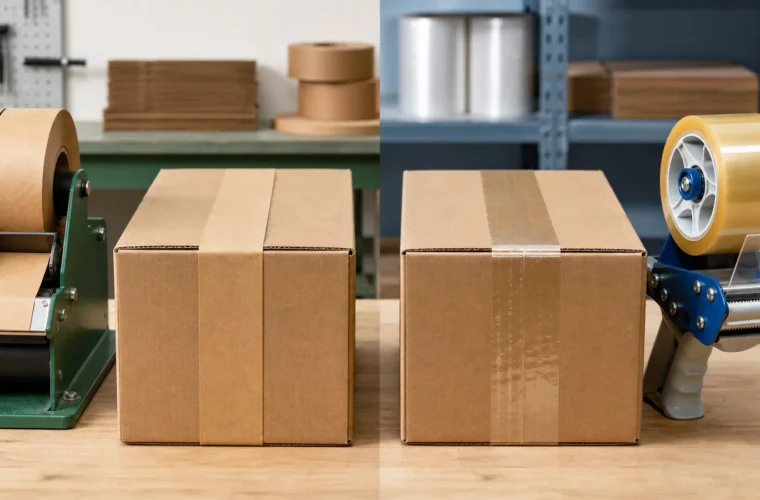
- wants to compare standard and reinforced kraft around real boxes;
- has stable artwork;
- can test the dispenser and workflow;
- can estimate roll use;
- wants to evaluate exterior branding before a larger order.
BrandTapeCo offers current small-order options for custom printed kraft paper tape beginning at five rolls per selected specification. Available widths are 1.89 in (48 mm) and 2.36 in (60 mm), with standard or reinforced kraft paper and one-color, two-color, or full-color printing.
Those options reduce the entry quantity, but they do not remove the need for a fit check, artwork proof, and carton test.
The ecommerce packaging supplies guide helps a small brand stabilize boxes, closure, application records, and reorders before adding another custom item.
Compare Applied Cost, Not Only Roll Price
The cost decision includes more than the printed roll.
Record:
- finished roll length and width;
- material and reinforcement;
- number of print colors;
- tape used per box;
- dispenser or equipment requirement;
- packing time;
- artwork preparation and proof approval;
- unusable stock after design changes;
- shipping and order-specific commercial terms;
- whether custom tape replaces another branding item.
If custom tape replaces a separate sticker step, the workflow comparison may improve. If it is simply added on top of printed boxes, stickers, tissue, and inserts, the packaging system may be paying for duplicated messages.
Use the custom tape quote factors guide to prepare comparable supplier requests without inventing a universal cost per box.
A Go / Wait / Skip Decision Table
| Decision | Use it when |
|---|---|
| Go | Cartons, artwork, application, volume, and branding purpose are stable enough to test |
| Wait | The business expects custom tape to fit but still needs fulfillment approval, artwork lock, or a carton test |
| Skip | The business rarely uses cartons, cannot control application, or gains little from exterior tape branding |
Revisit the decision when the underlying facts change. A brand that should skip custom tape today may become a strong fit after its fulfillment and carton mix stabilize.
Frequently Asked Questions
Is custom packing tape worth it for a very small business?
It can be if the business regularly ships cartons, has stable artwork, controls the packing process, and can use the ordered rolls. Size alone does not determine fit.
What if I only ship a few boxes per month?
Estimate how long the rolls would remain in inventory and how likely the artwork is to change. Plain tape, stickers, or a stamp may preserve more flexibility.
Should I buy custom tape before custom boxes?
It depends on carton variety, order volume, artwork stability, and the jobs each item must perform. Tape may offer flexibility across several plain box sizes, while printed boxes provide a larger design surface.
Can custom tape fix boxes that open during shipping?
Printing does not correct a material, carton, fill, seam, dispenser, or application problem. Diagnose and test the closure system first.
Is plain tape bad for branding?
No. Plain tape can be an intentional operational choice while branding appears on the product, insert, label, or inside presentation.
What is the BrandTapeCo minimum order?
The current BrandTapeCo product page states that small custom orders start at five rolls per selected specification. Confirm current terms on the product page before ordering.
Conclusion: Is Custom Tape Worth It for a Small Business?
Custom tape for a small business is usually not worth ordering yet when the operation cannot control application, expects the artwork to change, rarely ships cartons, has not stabilized the closure process, or gains little from another exterior brand element.
Plain tape is often the correct temporary or permanent choice in those cases. When the carton, workflow, artwork, and consumption plan are ready, a small controlled custom order becomes easier to justify.
If your operation passes that fit check, review BrandTapeCo’s custom packing tape overview and test the selected material, width, artwork, and dispenser on representative cartons before production.
Next step: see custom packing tape for small orders for current configurations and order-specific details.